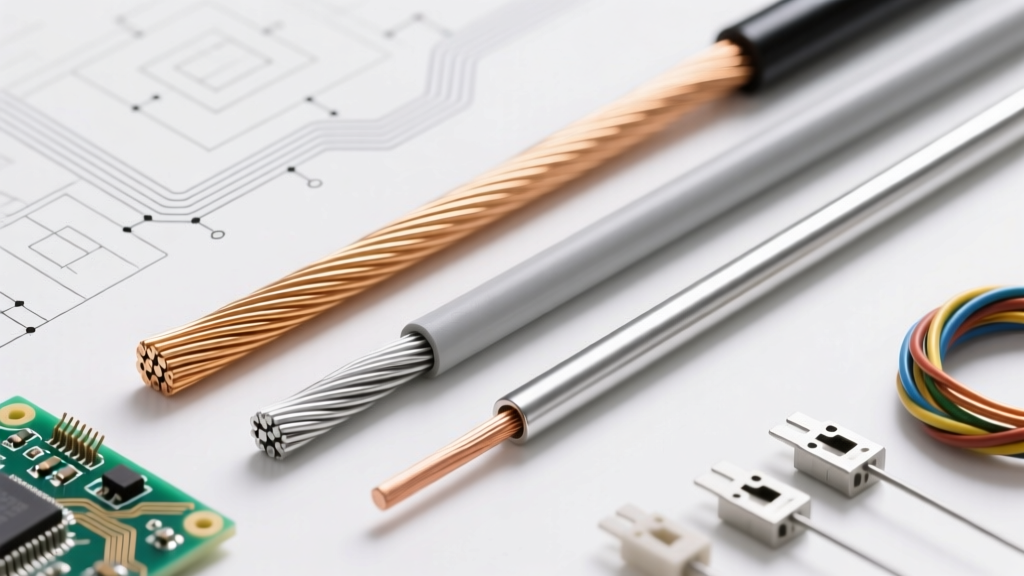

The Physics and Standards Behind Conductors of Energy
When electrical engineers and electricians discuss conductors of energy, they are referring to materials that allow the free flow of electrical charge carriers—typically electrons—with minimal resistance. In solid-state physics, this is governed by band theory, where the valence band and conduction band overlap, creating an 'electron sea' that responds instantly to an applied electromagnetic field.
To objectively compare different conductors of energy, the electrical industry relies on the International Annealed Copper Standard (IACS). Established in 1913, the IACS defines the conductivity of annealed electrolytic tough pitch (ETP) copper as exactly 100%. Every other conductive material is measured as a percentage of this baseline. According to data from the National Institute of Standards and Technology (NIST), resistivity is highly temperature-dependent, meaning the ambient operating environment drastically alters a material's real-world ampacity and voltage drop characteristics.
The Big Three: Material Comparison Matrix
Selecting the right conductor requires balancing electrical efficiency, mechanical strength, weight, and economic feasibility. Below is a head-to-head comparison of the three most prominent bulk conductors of energy used in modern infrastructure and electronics.
| Material | Conductivity (% IACS) | Resistivity @ 20°C (nΩ·m) | Density (g/cm³) | Cost Index (Relative) | Primary Application |
|---|---|---|---|---|---|
| Silver (Ag) | 105% | 15.87 | 10.49 | ~50x - 100x Cu | RF/Microwave, High-end Audio, Aerospace |
| Copper (Cu) | 100% (Baseline) | 16.78 | 8.96 | 1x (Baseline) | Branch wiring, Motors, PCBs, Transformers |
| Aluminum (Al) | 61% (1350 Alloy) | 27.50 | 2.70 | ~0.3x Cu | Transmission lines, Service entrances, Feeders |
| Gold (Au) | 70% | 22.14 | 19.30 | ~1000x Cu | Low-voltage signal contacts, IC bonding wires |
Deep Dive: Field Realities and Failure Modes
While theoretical conductivity tables are useful, real-world electrical systems fail not because of the bulk material, but because of termination physics, environmental degradation, and mechanical creep. Understanding these failure modes is critical for any electrical professional.
Copper: Thermal Creep and the Skin Effect
Copper, specifically C11000 ETP (Electrolytic Tough Pitch), is the undisputed standard for residential and commercial branch circuits. Its mechanical tensile strength and resistance to 'cold flow' (creep) make it highly reliable under screw-type terminations. However, copper is not immune to physics. At high frequencies (above 10 kHz), the skin effect forces the electrical current to travel only along the outer periphery of the conductor. This effectively reduces the cross-sectional area available for conduction, increasing AC resistance. In high-frequency busbars and RF coils, engineers mitigate this by using flat copper ribbons or Litz wire (individually insulated, braided strands) rather than solid, thick conductors.
Aluminum: Galvanic Corrosion and Termination Failures
Aluminum is a highly efficient conductor of energy when factoring in weight-to-conductivity ratios. A pound of aluminum can carry roughly twice the current of a pound of copper. This makes it the mandatory choice for high-voltage overhead transmission lines. However, its use in residential branch wiring during the 1960s and 70s resulted in widespread electrical fires. The culprit was not the aluminum itself, but the use of pure 1350-series aluminum paired with standard brass screw terminals.
Aluminum has a coefficient of thermal expansion (CTE) roughly 30% higher than brass. As loads cycled on and off, the aluminum wire expanded and contracted, eventually 'creeping' out from under the terminal screw. This loosened the connection, increased contact resistance, and caused localized arcing and extreme heat. Today, the National Electrical Code (NEC) mandates the use of AA-8000 series alloys for building wire, which incorporate iron, copper, and magnesium to stabilize the metal's crystalline structure and eliminate creep. Furthermore, Article 110.14 of the NEC requires specific anti-oxidant pastes and COF (Copper-Filled Aluminum) or bimetallic lugs to prevent galvanic corrosion when aluminum connects to copper.
Silver: RF Migration and Tarnish Dynamics
Silver is the most conductive elemental metal on Earth, boasting 105% IACS. Why isn't it used for house wiring? Beyond the prohibitive cost, silver is highly susceptible to sulfur-induced tarnishing (silver sulfide) and electromigration under DC bias in high-humidity environments. However, silver's dominance as a conductor of energy shines in radio frequency (RF) and microwave applications. Because of the skin effect mentioned earlier, high-frequency signals only penetrate the first few micrometers of a wire. By simply silver-plating a copper core, engineers achieve the ultra-low RF resistance of silver while maintaining the tensile strength and cost-efficiency of copper. This is the standard for aerospace coaxial cables and high-end audio interconnects.
Engineering Insight: Never use standard wire nuts to splice copper and aluminum conductors. The electrochemical potential difference between the two metals, combined with ambient moisture, creates a galvanic cell that rapidly corrodes the aluminum, leading to high-resistance open circuits or localized melting. Always use UL-listed Al/Cu bimetallic connectors or specialized crimp systems.
Specialized Conductors: Gold and Superconductors
While copper, aluminum, and silver handle bulk power transfer, specialized applications require different conductors of energy based on chemical rather than electrical properties.
- Gold (Au): With a conductivity of only 70% IACS, gold is a poor choice for power transmission. However, gold is entirely noble; it does not form an insulating oxide layer in atmospheric conditions. In low-voltage, low-current digital logic circuits (like HDMI pins, PCB edge connectors, and semiconductor bonding wires), a microscopic layer of oxide on copper or aluminum would completely block the signal. Gold guarantees a pristine, low-resistance contact surface for data and signal energy.
- Superconductors: Materials like Yttrium Barium Copper Oxide (YBCO) exhibit zero electrical resistance when cooled below their critical temperature. While currently impractical for consumer electronics due to cryogenic requirements, superconductors are actively deployed as conductors of energy in MRI machines, particle accelerators, and experimental high-capacity urban power grid links where spatial constraints prohibit traditional copper busways.
Engineering Decision Framework: Choosing Your Conductor
When designing a circuit or sizing a feeder, use this practical framework to select the optimal conductor of energy:
- Evaluate the Weight-to-Ampacity Ratio: If designing for aerospace, automotive, or long-span overhead transmission, choose Aluminum (AA-8000 or 1350-H19). The 61% IACS conductivity is easily offset by upsizing the wire gauge by one or two AWG sizes, resulting in a net weight savings of over 50% compared to copper.
- Assess the Termination Environment: If the equipment features standard brass or copper busbar terminations without specialized bimetallic lugs, default to Copper (C11000). The labor cost and liability risk of improperly terminating aluminum in a commercial panel far outweigh the material savings.
- Analyze the Frequency Spectrum: For DC or 50/60Hz AC mains power, bulk copper or aluminum is ideal. For RF, microwave, or high-speed digital pulse transmission, specify silver-plated copper or utilize gold-flashed contacts to minimize skin-effect resistance and signal attenuation.
- Calculate Voltage Drop vs. Thermal Limits: According to the Copper Development Association (CDA), a conductor may be sized to handle the thermal load (ampacity) but still fail the voltage drop limit over long distances. In long-run solar PV arrays or agricultural feeders, aluminum is frequently upsized significantly to mitigate voltage drop while keeping project costs manageable.
Final Thoughts on Energy Conduction
The term 'conductors of energy' encompasses far more than a simple lookup table of resistivity values. True electrical mastery requires understanding how a material's atomic structure interacts with thermal cycling, mechanical stress, and electromagnetic frequencies. By matching the specific physical and chemical traits of copper, aluminum, silver, or gold to the exact demands of your application, you ensure maximum efficiency, longevity, and safety in any electrical system.


