
Introduction to 220V Water Heater Circuits & NEC Compliance
Installing or replacing a residential storage water heater is one of the most common high-amperage electrical tasks a DIYer or apprentice electrician will face. While modern units are highly efficient, they still demand substantial power, typically operating on a 240-volt (commonly referred to as 220V) dedicated circuit. When reviewing an electric water heater wiring diagram 220 configurations require strict adherence to the National Electrical Code (NEC) to prevent catastrophic failures, electrical fires, and fatal shocks.
As of the 2023 and upcoming 2026 NEC adoption cycles, the rules governing appliance circuits have become increasingly stringent. This guide moves beyond generic diagrams to provide actionable, code-compliant instructions, exact torque specifications, and real-world troubleshooting insights for 4500W and 5500W 240V electric water heaters.
CRITICAL SAFETY WARNING: Before opening any junction box or thermostat cover, you must perform Lockout/Tagout (LOTO) procedures at the main service panel. Verify the absence of voltage using a Category III or IV multimeter across both line terminals and ground. Relying solely on a non-contact voltage tester is a severe safety violation that can result in arc flash injuries. For official LOTO protocols, refer to the OSHA Hazardous Energy Control standards.
Decoding the Electric Water Heater Wiring Diagram 220V
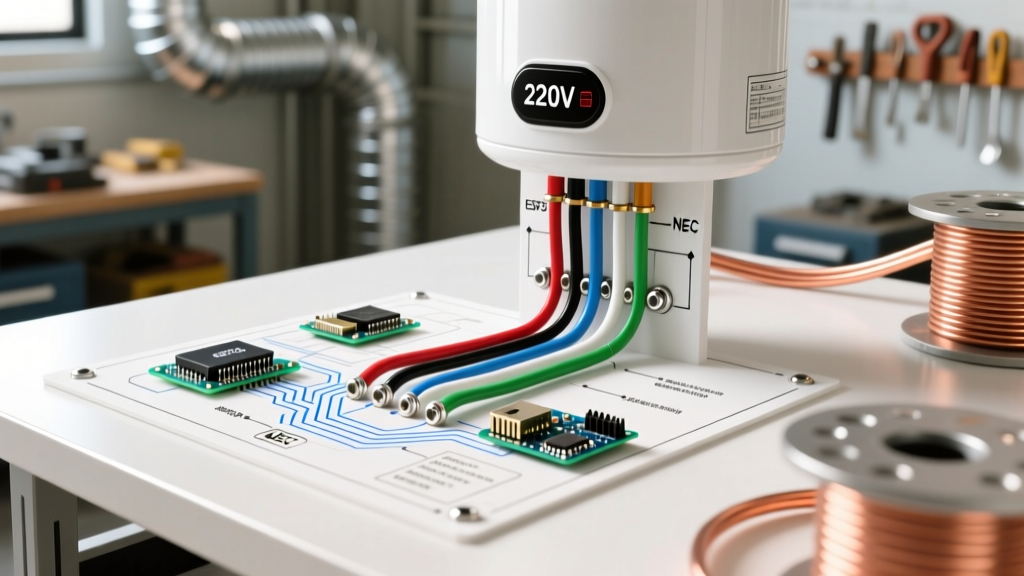
The standard 240V electric water heater does not require a neutral wire. It operates purely on two ungrounded (hot) conductors and an equipment grounding conductor (EGC). Understanding the internal routing of these wires is critical for proper operation and safety.
Line 1, Line 2, and Ground Connections
- Line 1 (Black Wire): Routes from the 2-pole breaker, enters the water heater junction box, and connects directly to the upper thermostat's L1 terminal.
- Line 2 (White Wire re-identified as Hot): Routes from the breaker, enters the junction box, and connects to the upper thermostat's L3 terminal. Code Note: Because standard 10/2 NM-B cable contains a white wire, NEC 200.7(C)(2) mandates that this white wire must be permanently re-identified with black or red electrical tape or marker at both the panel and the appliance junction box to indicate it is an ungrounded hot conductor.
- Ground (Bare Copper): Connects directly to the green grounding screw inside the junction box, which is mechanically bonded to the steel chassis of the tank.
The upper thermostat acts as the primary routing switch. It distributes power to the upper heating element. Once the upper tank reaches the set temperature, the internal bimetallic switch flips, sending Line 2 power down to the lower thermostat, which then powers the lower element. This simultaneous interlock prevents both elements from running at once, which would exceed standard residential branch circuit limits.
NEC Code Requirements for 220V Heaters (Article 422)
Sizing your breaker and wire correctly is not a guessing game; it is a mathematical requirement dictated by NEC Article 422 (Appliances). Specifically, NEC 422.13 states that storage water heaters with a capacity of 120 gallons or less must have an overcurrent protective device (OCPD) rated at not less than 125% of the appliance's nameplate rating.
| Heater Wattage | Voltage | Base Amperage | 125% NEC Multiplier | Min Breaker Size | Min Copper Wire (THHN/NM-B) |
|---|---|---|---|---|---|
| 3000W | 240V | 12.5A | 15.6A | 20A | 12 AWG |
| 4500W (Standard) | 240V | 18.75A | 23.4A | 25A or 30A | 10 AWG |
| 5500W (High Output) | 240V | 22.9A | 28.6A | 30A | 10 AWG |
| 8000W (Commercial) | 240V | 33.3A | 41.6A | 45A or 50A | 8 AWG |
Expert Insight: While a 4500W heater mathematically requires a 23.4A breaker, 25A breakers are less common in residential retail. Therefore, a 30A double-pole breaker paired with 10 AWG copper wire is the industry standard and fully code-compliant for both 4500W and 5500W units.
Step-by-Step Compliant Wiring Procedure
Follow these precise steps to ensure a safe, inspection-ready installation. For broader context on appliance energy consumption and efficiency standards, consult the U.S. Department of Energy water heating guidelines.
- Prepare the Cable: Strip the outer NM-B jacket, leaving at least 1/4 inch of the outer sheath extending into the water heater's junction box to protect the inner wire insulation from the sharp metal edges of the knockout hole.
- Re-identify the Neutral: Wrap black or red electrical tape around the white wire's insulation at the panel and the junction box, leaving the tips bare for termination.
- Terminate the Ground First: Loop the bare copper wire clockwise around the green grounding screw. Tighten to the manufacturer's specified torque (typically 12 to 15 in-lbs). A loose ground will not trip the breaker during a chassis fault.
- Connect Line Conductors: Insert the black and re-identified white wires into the upper thermostat's L1 and L3 screw terminals. Ensure no bare copper is exposed outside the terminal block (preventing short circuits) and that no insulation is trapped under the screw head (causing high-resistance hot spots).
- Secure the Cable Clamp: Tighten the Romex connector strain relief so the cable cannot be pulled out of the junction box without significant force.
Common Code Violations & Failure Modes
During electrical inspections and service calls, master electricians frequently encounter the same dangerous shortcuts. Avoid these critical failure modes:
- Undersized Wiring on 30A Breakers: Using 12 AWG wire on a 30A breaker is a direct violation of NEC 240.4(D) and a severe fire hazard. The wire will melt before the breaker trips during a sustained overload.
- Relying on Plumbing Pipes for Grounding: Older installations sometimes omit the EGC, assuming the copper water pipes will ground the unit. NEC 250.112 explicitly prohibits using metallic water piping systems as the sole equipment grounding conductor for appliances. A dedicated ground wire is mandatory.
- Missing Junction Box Covers: Leaving the thermostat access panels off exposes live 240V terminals. This violates NEC 110.28 regarding enclosure requirements and poses an electrocution risk to anyone inspecting the area.
- Using NM-B Cable in Wet Locations: If the water heater is located outdoors or in a consistently damp, unconditioned crawlspace where condensation drips onto the cable, standard Romex (NM-B) is prohibited. You must use THHN/THWN-2 wires pulled through liquid-tight flexible metal conduit or rigid PVC.
GFCI and AFCI Requirements: Do You Need Them?
A frequent question among DIYers is whether a hardwired 220V water heater requires a Ground Fault Circuit Interrupter (GFCI) or Arc Fault Circuit Interrupter (AFCI).
Under standard NEC rules, hardwired 240V water heaters do not require GFCI or AFCI protection. GFCI requirements in NEC 210.8(F) apply to 125V/250V receptacles (outlets) supplying dishwashers, and AFCI rules generally apply to 120V branch circuits in living spaces. However, if you are installing a specialized portable water heater that plugs into a 240V receptacle, or if your local municipality has adopted strict amendments requiring GFCI breakers for all appliances in garages or basements, you must comply with local codes. Always check with your local Authority Having Jurisdiction (AHJ).
Expert Troubleshooting & Multimeter Testing
If the water heater is wired correctly but fails to produce hot water, use this diagnostic matrix before replacing elements:
1. Verify Supply Voltage
Set your multimeter to AC Voltage (V~). Place probes on L1 and L2 at the upper thermostat. You should read between 230V and 245V. If you read 0V, the issue is at the breaker panel. If you read 120V, one pole of the double-pole breaker has failed or a hot wire is disconnected.
2. Test the ECO (Energy Cut-Off) Reset
Locate the red reset button on the upper thermostat. If it has tripped, the water temperature exceeded 150°F (65°C), usually due to a stuck thermostat contact or a failed lower element forcing the upper element to run continuously. Press the button. If it clicks and power is restored, monitor the unit. If it trips again within 24 hours, replace both thermostats immediately.
3. Element Continuity Check
Turn off the power. Disconnect the wires from the heating element screws. Set the multimeter to Ohms (Ω). Place probes on the element's two screws. A healthy 4500W element should read approximately 12.8 ohms. A reading of 'OL' (Open Loop) indicates a burnt-out element requiring replacement.
Frequently Asked Questions (FAQ)
Can I use aluminum wire for a 220V water heater?
Yes, but you must upsize the wire. While 10 AWG copper is rated for 30A, you must use 8 AWG aluminum for a 30A circuit. Furthermore, you must apply an antioxidant compound (like Noalox) to the aluminum strands before terminating them at the thermostat to prevent galvanic corrosion and high-resistance heating, which causes fires. Always verify the thermostat terminals are rated for aluminum (marked AL/CU).
Why does my 240V water heater have a 3-wire setup with a neutral?
Standard residential tank heaters do not use a neutral. If you see a 3-wire setup (Black, Red, White) plus a ground, it is likely feeding a smart water heater with 120V control boards, or it is a miswired circuit from a previous owner. Never use the neutral as a ground, and never bond neutral to ground at the appliance.
Where can I find the official NEC codes for appliances?
The National Fire Protection Association (NFPA) publishes the National Electrical Code, which is updated every three years. Article 422 covers the specific appliance wiring rules detailed in this guide.
Final Safety Verification
Once all connections are torqued, wires are neatly folded into the junction box, and covers are secured, restore power at the main panel. Listen for the faint hum of the contactor or the subtle heating sound from the tank. Use a non-contact voltage tester near the junction box to ensure no stray fields are escaping, and verify the hot water output at the nearest faucet within 45 minutes. Proper adherence to the electric water heater wiring diagram 220 standards ensures decades of safe, reliable hot water without the risk of electrical fire.