
The Cordless Soldering Bottleneck: Why Tip Selection Matters
The transition from butane-powered cordless irons to lithium-ion platforms revolutionized field electronics repair, automotive wiring, and RC hobbyist workflows. At the forefront of this shift is the Milwaukee 2488-20 M12 Soldering Iron. However, as we navigate the 2026 landscape of cordless soldering, a persistent bottleneck remains for both seasoned technicians and DIYers: the tip ecosystem. Searching for the right Milwaukee M12 soldering iron tips often leads to confusion regarding compatibility, thermal mass, and battery efficiency.
Unlike traditional benchtop stations that rely on standardized tip formats, cordless irons operate under strict power budgets. The wrong tip profile won't just ruin your solder joint; it will trigger voltage sag, prematurely drain your M12 battery, and potentially damage sensitive PCB pads through excessive dwell time. This comprehensive guide dissects the OEM tip lineup, debunks third-party compatibility myths, and provides a data-driven framework for selecting the exact tip your next project demands.
The Proprietary Ecosystem: OEM vs. Third-Party Myths
The most frequent question in electronics repair forums regarding the 2488-20 model is whether it accepts industry-standard tips. The short answer is no. The Milwaukee M12 utilizes a proprietary threaded screw-on collar mechanism designed to secure the tip directly to the internal ceramic heating element.
Compatibility Warning: The Milwaukee M12 does not accept Hakko 900M series, Weller ETA series, or Pinecil/TS100 tips. Attempting to force or modify standard slip-in tips will destroy the fragile thermocouple wiring inside the M12's heating core.
In 2026, the market is flooded with counterfeit 'compatible' M12 tips sold in bulk on third-party marketplaces for a fraction of the OEM price. While the physical threading may match, these aftermarket tips typically lack a solid copper core, relying instead on cheap steel alloys with poor thermal conductivity. According to testing data reviewed by Pro Tool Reviews, counterfeit tips exhibit a 40% slower thermal recovery time, forcing the iron's internal PID controller to run at a 100% PWM duty cycle, which rapidly degrades the M12 battery cell and burns out the heating element.
2026 OEM Tip Lineup & Thermal Comparison Matrix
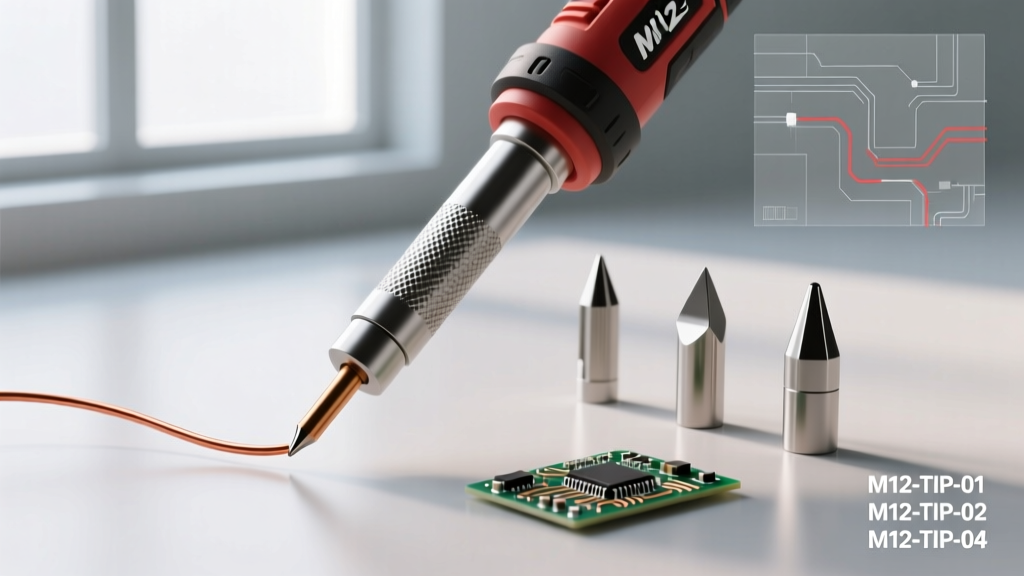
Milwaukee's official accessory documentation categorizes their replacement tips by specific application profiles. Below is a comparison matrix of the primary OEM options available for the M12 platform, detailing their thermal characteristics and ideal use cases.
| Tip Profile | OEM Part Number | Thermal Mass | Ideal Application | Avg. Heat-Up (to 350°C) |
|---|---|---|---|---|
| Standard Chisel | 48-90-5000 | Medium | Through-hole, 18-14 AWG wire, XT30 | ~45 seconds |
| Fine Point / Conical | 48-90-5005 | Low | SMD 0805/0603, signal wires, pitch headers | ~35 seconds |
| Heavy-Duty Chisel | 48-90-5010 (Regional) | High | XT60/XT90 connectors, 12-10 AWG, ground planes | ~65 seconds |
Deep Dive: The Standard Chisel (48-90-5000)
The 48-90-5000 is the workhorse of the M12 lineup. Its 2.4mm slanted face provides an optimal balance between surface area contact and maneuverability. For general electrical work—such as tinning 16 AWG silicone wire or soldering standard 2.54mm pitch header pins—this tip maintains a stable intermetallic compound (IMC) layer without requiring excessive downward pressure. The medium thermal mass ensures that when the tip touches a copper wire, the temperature drop is minimal, allowing the iron's 75-watt equivalent burst to recover the heat in under two seconds.
Deep Dive: Fine Point / Conical (48-90-5005)
While conical tips are often misunderstood by beginners as 'universal' tips, they are highly specialized. The 48-90-5005 features a needle-like taper that excels in tight spaces, such as reworking 0805 surface-mount resistors or repairing drone flight controller pads. However, because the tip's physical mass is concentrated at the base and tapers to a microscopic point, it lacks the thermal inertia to solder anything larger than 22 AWG wire. Using this tip on a heavy ground plane will result in cold, grainy solder joints as the tip's temperature plummets upon contact.
Thermal Recovery & Battery Drain: The Hidden Cost
Cordless soldering is an exercise in power management. The Milwaukee M12 Soldering Iron draws heavily from the battery when the internal thermocouple detects a temperature drop. The tip you choose directly dictates your battery runtime and tool longevity.
- Low Thermal Mass (Point Tip): Heats up rapidly, drawing a high initial current spike, but requires less continuous power to maintain temperature on small SMD pads. Best paired with the compact M12 2.0Ah (48-11-2420) battery for lightweight, overhead, or drone-field repairs.
- High Thermal Mass (Heavy Chisel): Takes longer to reach the target 350°C, keeping the tool in a high-draw state for over a minute. When soldering large XT60 battery connectors, the tip absorbs massive amounts of heat. If paired with a smaller 2.0Ah battery, the voltage sag can trigger the M12's low-voltage cutoff, shutting the iron off mid-joint. For heavy tips, always upgrade to the M12 XC 4.0Ah (48-11-2440) or the newer 2026 high-output M12 cells.
IPC Standards and Pad Delamination Risks
Professional electronics manufacturing and repair are governed by strict thermal profiling guidelines. According to the IPC J-STD-001 requirements for soldered electrical and electronic assemblies, the dwell time (the duration the iron is in contact with the pad) should generally not exceed 2 to 3 seconds for standard FR-4 PCBs.
When technicians use an undersized Milwaukee M12 tip (like the 48-90-5005 conical) on a large thermal via or ground plane, the tip loses its heat instantly. The user compensates by holding the iron in place for 8 to 10 seconds, waiting for the solder to flow. This prolonged exposure to 350°C+ heat exceeds the glass transition temperature (Tg) of the PCB substrate, leading to pad delamination, lifted traces, and micro-fractures in the surrounding vias. Always match the tip's thermal mass to the thermal demand of the joint, not just the physical size of the pad.
Maintenance & Tinning Protocols for Cordless Irons
Cordless irons like the 2488-20 utilize aggressive heating curves to reach operating temperature quickly. This rapid thermal ramp-up can flash-burn rosin flux, leading to rapid tip oxidation (the dreaded 'black crust' that repels solder). To maximize the lifespan of your Milwaukee M12 soldering iron tips, abandon traditional wet sponges and adopt the following dry-maintenance protocol:
- Ditch the Wet Sponge: Touching a 350°C cordless tip to a wet cellulose sponge causes an immediate, violent thermal shock. This micro-fractures the iron plating on the tip's copper core, leading to pitting and permanent degradation.
- Use Brass Wire Wool: Always clean the tip using a dry brass wire sponge. Brass is softer than the iron plating but harder than the oxidized solder residue, stripping the crust without dropping the tip's core temperature.
- The 'Shut-Down' Tinning Rule: Never turn off the M12 iron with a bare tip. The moment you finish your final joint, melt a generous blob of 63/37 leaded solder (or high-flux SAC305) onto the tip before powering down. This sacrificial layer oxidizes in the air, protecting the actual tip plating underneath.
- Flux is Your Thermal Bridge: When soldering heavy wires with the M12, apply external no-clean flux to the wire before the iron touches it. The liquid flux acts as a temporary thermal bridge, transferring heat from the tip to the copper wire 30% faster than dry air, reducing dwell time and saving battery life.
Frequently Asked Questions (FAQ)
Can I re-tip the Milwaukee M12 heating element myself?
No. The heating element and thermocouple are sealed within the proprietary threaded barrel. If the internal ceramic heater fails or the thermocouple wire snaps, the entire tip-and-heater assembly must be replaced as a single unit, which is a known maintenance cost factor for the 2488-20 platform compared to modular benchtop stations.
What is the best temperature setting for the 48-90-5000 Chisel tip?
For standard 60/40 or 63/37 tin-lead solder, set the M12 dial to approximately 315°C (600°F). If you are using lead-free SAC305 solder, which has a higher melting point (217°C) and poor wetting characteristics, increase the dial to 350°C - 370°C. Avoid maxing out the dial to 400°C unless absolutely necessary, as this will burn the flux instantly and shorten tip life by up to 60%.
Are there any third-party tips that actually work?
As of 2026, a few specialized CNC manufacturers have begun producing high-copper-core screw-in tips that fit the M12 thread pitch. However, because Milwaukee frequently updates the internal collar depth and thermocouple contact points in silent hardware revisions, third-party tips remain a gamble. For critical field repairs where tool failure is not an option, sticking to OEM 48-90 series tips remains the only guaranteed path to reliable thermal transfer.
Final Verdict
The Milwaukee M12 Soldering Iron is a triumph of portable power, but its effectiveness is entirely gated by the tip at the end of the barrel. By understanding the thermal mass differences between the 48-90-5000 chisel and the 48-90-5005 conical, and by pairing the correct tip with the appropriate M12 battery capacity, you can transform this tool from a frustrating field compromise into a precision soldering powerhouse. Respect the proprietary ecosystem, maintain your tips with dry brass wool, and let the thermal dynamics guide your workflow.