
The Hidden Metallurgy of Soldering Tip Degradation
Before debating the tools, we must understand the enemy. Modern soldering tips are not solid copper; they are complex metallurgical sandwiches. A copper core provides thermal conductivity, plated with a 0.1mm to 0.8mm layer of iron to resist solder dissolution, followed by a chromium barrier, and finally a wetting layer of tin. When cleaning a soldering iron, your primary goal is to remove carbonized flux and metal oxides without breaching the microscopic iron plating.
In 2026, the industry-wide shift to lead-free alloys like SAC305 (Tin/Silver/Copper) demands sustained tip temperatures between 350°C and 380°C. At these elevated thermal thresholds, oxidation accelerates exponentially. According to the IPC J-STD-001 standard, maintaining proper wetting and preventing intermetallic compound (IMC) overgrowth is critical for reliable joints. The method you choose to clean your tip directly dictates whether that iron plating survives six weeks or six years.
The Budget Tier: Cellulose Sponges & Brass Wool ($2 - $15)
Budget cleaning methods rely on mechanical abrasion and thermal shock. While cheap upfront, they introduce severe variables that can compromise expensive soldering stations.
Wet Cellulose Sponges (The $2 Standard)
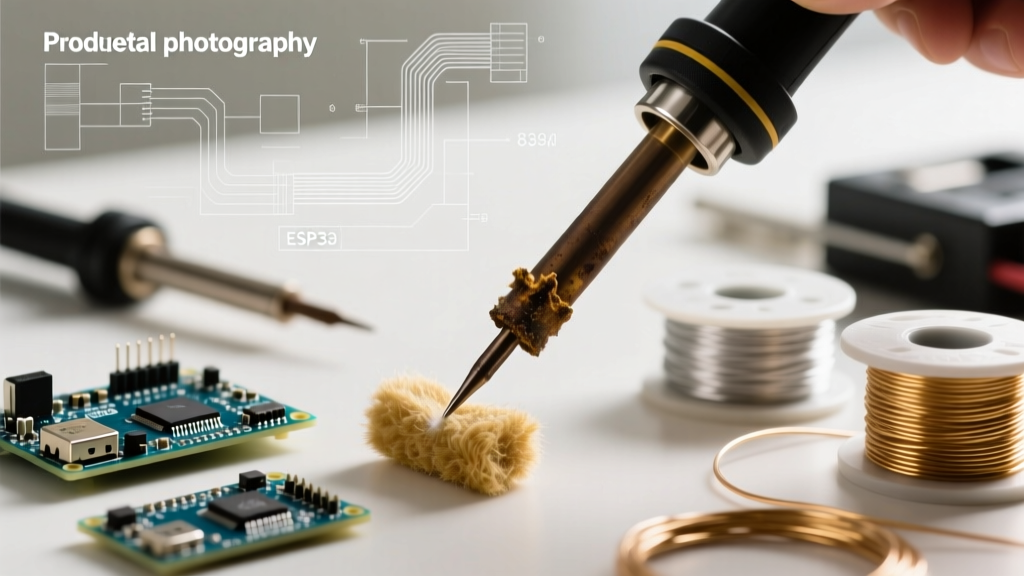
The ubiquitous yellow-and-brown cellulose sponge is included with almost every entry-level station. When saturated with distilled water, it cleans via a combination of mild abrasion and rapid thermal contraction.
- The Mechanism: Wiping a 380°C tip across a wet sponge causes an instantaneous surface temperature drop of up to 150°C.
- The Failure Mode: This extreme delta-T induces micro-fractures in the iron plating. Over time, molten solder penetrates these fissures, reaching the copper core. The copper dissolves into the solder (a process known as leaching), creating a hollow, pitted tip that is completely unrecoverable.
- Verdict: Acceptable only for low-temperature leaded work (under 300°C) on cheap, replaceable tips (e.g., Hakko T18 series at $12 each).
Brass Wire Tip Cleaners (The $8 Upgrade)
Often sold as generic "brass wool" in a metal dish, this is a massive improvement over wet sponges for high-temperature lead-free work.
- The Mechanism: The soft brass coils scrape off carbonized flux without dropping the tip temperature, maintaining your station's thermal recovery profile.
- The Edge Case: Low-quality, unbranded brass wool sheds microscopic metal splinters. If these embed into your PCB pads, they can cause latent short circuits or Foreign Object Debris (FOD) failures in high-reliability aerospace or medical assemblies.
- Verdict: The best budget option, provided you buy branded versions (like the Hakko 599B at $14) that use properly annealed, low-shedding brass.
The Premium Tier: Chemical Tippers & Automated Stations ($15 - $150+)
Premium methods prioritize chemical reduction and zero-abrasion mechanics, extending the life of high-end tips (like the Weller RT series at $48 each) by years.
Chemical Tip Tinner/Activators ($12 - $20)
Products like the Hakko FS-100 or MG Chemicals 4901 are not just cleaners; they are chemical re-tinning agents. They consist of a paste containing salicylic acid, ammonium chloride, and fine solder powder.
Expert Insight: When a tip turns black and refuses to wet, mechanical scraping will destroy it. Dipping the oxidized tip into a chemical tinner reduces the iron oxide back to bare metal while simultaneously depositing a fresh layer of solder, all in under three seconds.
Automated Tip Cleaners ($110 - $160)
For production environments or high-end hobbyist benches, motorized cleaners like the Weller WDC2 or Hakko FA-430 represent the pinnacle of tip care.
- Weller WDC2 (~$125): Uses a motorized, continuously dampened sponge system that rotates the tip at a precise RPM, ensuring 360-degree cleaning without manual pressure or thermal shock.
- Hakko FA-430 (~$145): Utilizes a specialized chemical pad and vacuum system to extract toxic flux fumes directly at the cleaning point, protecting the operator's respiratory health while preserving the tip.
Head-to-Head Comparison Matrix
| Cleaning Method | Est. Cost (2026) | Thermal Shock Risk | Plating Wear | Best Application |
|---|---|---|---|---|
| Wet Cellulose Sponge | $2 - $5 | Extreme (High Delta-T) | High (Micro-cracking) | Low-temp leaded hobby work |
| Brass Wool (Branded) | $10 - $15 | None (Dry contact) | Low (Mild abrasion) | Daily lead-free prototyping |
| Chemical Tip Tinner | $12 - $20 | None (Chemical reaction) | Negative (Restores plating) | Rescuing oxidized/dead tips |
| Automated Cleaner (e.g., WDC2) | $120 - $160 | Minimal (Controlled moisture) | Negligible | Production benches, SMD rework |
The ROI of Premium Tip Care: A 2026 Cost Analysis
Why invest $125 in an automated cleaner? Let us look at the mathematics of a professional or heavy-hobbyist bench. Technical guidelines from Weller Tools emphasize that improper cleaning is the number one cause of premature tip failure.
Assume you are using a premium micro-soldering setup with Weller RT1 tips, which retail for roughly $48 each in 2026. If you use a wet sponge on a 380°C lead-free profile, thermal shock will typically degrade the iron plating within 40 hours of active use. Replacing the tip weekly costs $2,496 per year.
By switching to a Weller WDC2 automated cleaner and a brass wool hybrid routine, tip lifespan easily extends to 250+ hours. You will buy roughly two tips a year ($96). The $125 automated cleaner pays for itself in the first three weeks of operation through tip savings alone, not to mention the reduction in scrapped PCBs due to cold joints from poorly wetted tips.
The Optimal Hybrid Cleaning Protocol
You do not need to buy a $150 machine to achieve premium results. The most effective protocol for 90% of users combines budget mechanical cleaning with premium chemical maintenance.
- During Active Soldering (Every 3-5 joints): Use a branded brass wool cleaner. Plunge the tip in, twist once, and withdraw. This removes bulk carbon without dropping the temperature.
- Post-Soldering (Tinning before power-off): Never turn off your station with a bare tip. Apply a massive blob of cheap, leaded 63/37 rosin-core solder to the tip. This acts as a sacrificial oxidation layer while the tip cools.
- Weekly Maintenance (The Premium Step): Once a week, or whenever wetting slows down, dip the hot tip into a Chemical Tip Tinner (like Hakko FS-100) for 2 seconds, then immediately wipe it on your brass wool. This dissolves microscopic oxides that brass alone cannot remove.
Expert Troubleshooting FAQ
My tip has a black, crusty layer that brass wool won't remove. Is it dead?
Not yet. That black crust is heavily carbonized flux mixed with tin oxide. Do not use sandpaper, a file, or a Dremel. Abrasives will instantly strip the 0.1mm iron plating, exposing the copper core and permanently destroying the tip. Instead, use a chemical tip tinner, or apply a specialized copper braid soaked in high-activity liquid flux (like Amtech NC-559) and gently wipe the tip while it is at 300°C.
Can I use tap water in my cellulose sponge?
No. Tap water contains dissolved minerals (calcium, magnesium, chlorine). When the water flash-boils against a 380°C tip, these minerals are baked onto the iron plating, creating an insulating silicate layer that destroys thermal transfer. Always use distilled or deionized (DI) water, and ensure the sponge is only damp, not dripping wet.
What causes physical pitting (craters) on the tip surface?
Pitting is caused by copper dissolution. This happens when the iron plating is breached (usually via thermal shock from a wet sponge or mechanical scratching), allowing the molten solder to eat into the copper core. According to Hakko's official metallurgy documentation, once pitting is visible, the tip's thermal mass is compromised, and it must be discarded to prevent cold solder joints and erratic temperature readings.