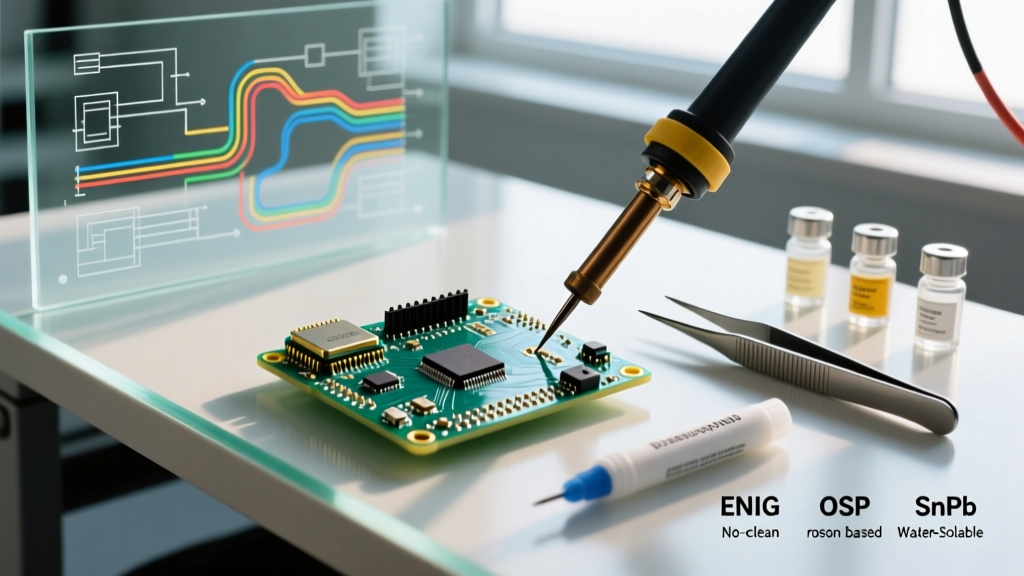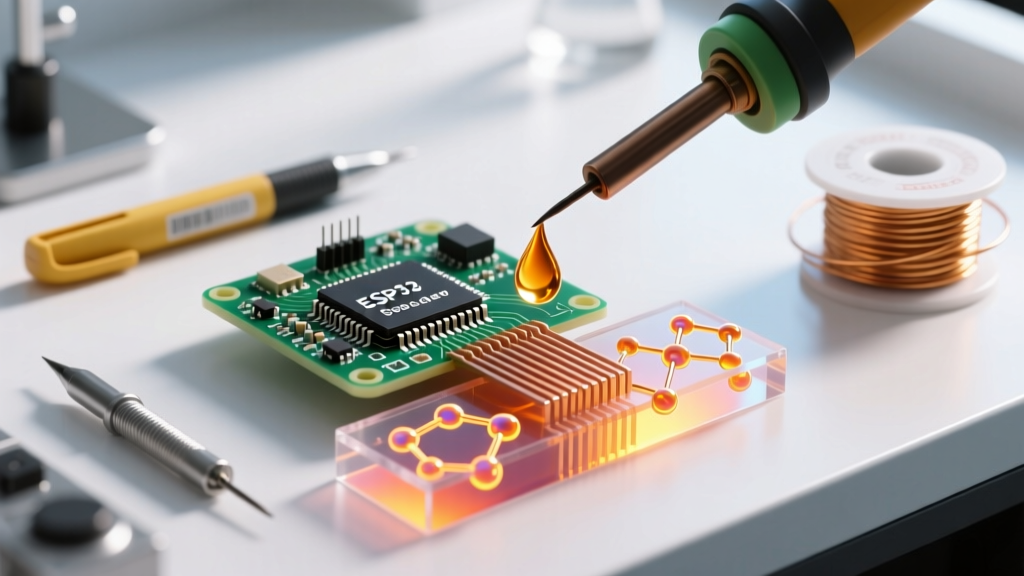

At the workbench, rosin soldering is often reduced to a simple mechanical action: melt the wire, flow the joint. However, from a material science perspective, the process is a complex orchestration of organic chemistry, thermodynamics, and metallurgical interfacial dynamics. Rosin (colophony) is not merely a sticky binder; it is a highly specialized chemical solvent designed to manipulate surface tension and reduce metal oxides at precise thermal thresholds. Understanding the molecular behavior of rosin flux is critical for diagnosing solder defects, optimizing thermal profiles, and ensuring long-term electromigration reliability in modern PCB assemblies.
The Molecular Anatomy of Rosin Flux
Rosin is a solid form of resin obtained from pines, primarily Pinus palustris. When raw pine resin is distilled to remove volatile liquid terpenes (turpentine), the remaining solid, glassy material is colophony. The primary active chemical constituent of colophony is abietic acid (C20H30O2), a tricyclic diterpene carboxylic acid, alongside smaller concentrations of pimaric acid and other isomers.
In its solid state at room temperature, abietic acid is relatively inert and non-corrosive, which makes it an ideal matrix for electronics. However, its molecular structure contains a reactive carboxyl group (-COOH) and conjugated double bonds. It is the thermal excitation of these specific functional groups that enables the fluxing action. According to foundational material science overviews of rosin and its derivatives, the isomerization of these acids under heat fundamentally alters their reactivity, transitioning them from a passive solid to an aggressive oxide-reducing agent.
Thermal Activation and Oxide Reduction
Copper and tin surfaces naturally form passivation layers of copper oxide (CuO, Cu2O) and tin oxide (SnO2) when exposed to ambient oxygen. These oxides act as physical and chemical barriers that prevent molten solder from wetting the substrate. Rosin flux functions through an acid-base reaction at elevated temperatures.
As the soldering iron transfers heat through the solder wire to the pad, the rosin core melts (typically between 120°C and 150°C, well below the solder's liquidus). Once the temperature reaches the activation threshold (typically 160°C to 220°C), the carboxyl groups of the abietic acid dissociate. The acid reacts with the metal oxides to form metal abietates (e.g., copper abietate) and water vapor:
Reaction Dynamics: CuO + 2 C20H30O2 → Cu(C20H29O2)2 + H2O
The resulting copper abietate is a metallic soap that is highly soluble within the molten rosin matrix. This effectively strips the oxide layer away from the copper pad, exposing pristine, highly reactive base metal just milliseconds before the solder alloy reaches its liquidus state.
The Role of Activators: Halides vs. Non-Halides
Pure rosin (classified as Type R) is a weak acid. For heavily oxidized boards or difficult-to-solder alloys, chemical activators are added to the rosin matrix to lower the activation energy and increase the reduction rate.
- Non-Halide Activators: Organic acids (like adipic or succinic acid) and amines are used in RMA (Rosin Mildly Activated) fluxes. They provide a moderate boost in cleaning power without leaving highly conductive ionic residues.
- Halide Activators: RA (Rosin Activated) fluxes utilize amine hydrochlorides or bromides. The halide ions (Cl-, Br-) aggressively attack stubborn oxides through localized electrochemical reduction. While superior for wetting, halide residues are highly hygroscopic and can cause dendritic growth and short circuits if not cleaned with a solvent like isopropyl alcohol or a specialized saponifier.
The strict classification and testing of these ionic residues are governed by industry benchmarks such as the IPC J-STD-004 standard for fluxes, which dictates rigorous Surface Insulation Resistance (SIR) testing to ensure long-term board reliability.
Interfacial Dynamics: Wetting and Surface Tension
Beyond chemical cleaning, rosin fundamentally alters the thermodynamics of the solder joint. Wetting is governed by Young's Equation, which balances the interfacial tensions between the solid substrate, the liquid solder, and the surrounding atmosphere.
Molten tin-lead (Sn63Pb37) or lead-free SAC305 (Sn96.5Ag3.0Cu0.5) alloys possess high surface tension, causing them to bead up on a PCB pad (a high contact angle, θ > 90°). The molten rosin flux acts as a surfactant. By coating the liquid solder and the substrate, it drastically reduces the liquid-vapor interfacial tension. This allows the molten alloy to flow outward, reducing the contact angle to θ < 30° and enabling capillary action to draw the solder deep into plated through-holes (PTH) and under fine-pitch QFN components.
Thermal Degradation: When Flux Becomes a Liability
A common failure mode in manual soldering is the thermal degradation of the rosin matrix. Abietic acid and its isomers have a strict thermal ceiling. When subjected to temperatures exceeding 300°C to 350°C for prolonged periods (often caused by an operator leaving a 400°C iron on a joint too long), the organic molecules undergo destructive polymerization and cross-linking.
This thermal abuse results in flux charring. The once-clear, amber rosin turns into a hard, black, carbonized mass. This char is not merely cosmetic; it physically traps volatile outgassing beneath the solder surface, leading to internal voiding. Furthermore, charred flux loses its surfactant properties entirely, causing immediate dewetting—where the solder violently pulls back from the edges of the pad, leaving a grainy, disturbed joint that is highly susceptible to mechanical fatigue and thermal cycling cracks.
Comparative Matrix: Rosin Classifications and Thermal Tolerances
Selecting the correct rosin formulation requires balancing cleaning power against residue safety. The following matrix outlines standard rosin classifications based on IPC frameworks and modern material science applications:
| Flux Type | Chemical Composition | Activation Temp Range | Residue Conductivity | Cleaning Requirement |
|---|---|---|---|---|
| Type R (Pure Rosin) | 100% Colophony / Abietic Acid | 170°C - 210°C | Non-Conductive (Safe) | Optional (Aesthetic only) |
| Type RMA (Mildly Activated) | Rosin + Organic Acids/Amines | 160°C - 220°C | Very Low (Generally Safe) | Recommended for high-impedance |
| Type RA (Activated) | Rosin + Halide Salts (Cl/Br) | 150°C - 240°C | High (Corrosive Risk) | Mandatory (Solvent/Saponifier) |
| Synthetic Rosin (No-Clean) | Hydrogenated/Modified Resins | 180°C - 250°C | Negligible (Encapsulated) | Not Required |
Practical Application: Selecting Rosin-Core Alloys in 2026
As of 2026, the market for rosin-core solder wire has stabilized, with distinct product lines catering to both legacy through-hole designs and modern high-density SMD rework. When sourcing materials, technicians must look beyond the alloy and scrutinize the flux core percentage and formulation.
- Kester 44 (RA Rosin): The industry benchmark for heavy-duty through-hole and oxidized wire soldering. Utilizes a highly active halide-based rosin core. In 2026, a 1 lb spool of 0.031" (0.80mm) Sn63Pb37 Kester 44 retails between $48.00 and $58.00. It requires post-soldering cleaning with 99% IPA or a dedicated flux remover to prevent long-term corrosion.
- Multicore Crystal 500 (RMA/Synthetic Hybrid): A premium choice for mixed-technology boards. It features a 2.2% flux core with a halide-free activator system that provides RA-like wetting speeds but leaves a safe, no-clean residue. Pricing for a 500g spool of SAC305 (lead-free) sits around $75.00 to $85.00, reflecting the premium on silver-bearing alloys.
- Kester 245 (Low-Solids No-Clean): While technically a synthetic rosin-derivative, 245 is the standard for modern SMD rework where cleaning under bottom-terminated components (BTCs) is impossible. It utilizes a modified resin matrix that hardens into a clear, glass-like barrier post-reflow, actively preventing moisture ingress. A 1 lb spool of Sn63Pb37 costs approximately $42.00 to $50.00.
For detailed chemical safety data and specific gravity metrics on these formulations, technicians should consult the manufacturer's technical resource libraries to ensure compatibility with their specific rework station profiles.
Step-by-Step: Mitigating Rosin-Related Solder Defects
Even with premium materials, improper thermal management will ruin the flux chemistry. Follow this protocol to avoid common rosin-induced failures:
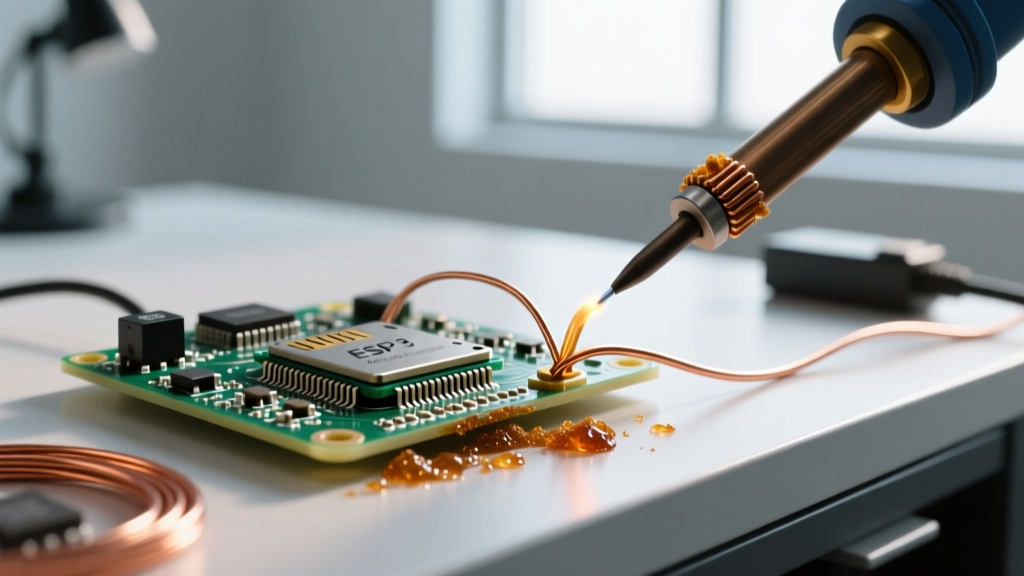
- Prevent Flux Boil-Off (Spatter): If the iron tip exceeds 380°C, the rosin core will flash-boil before it can wet the pad, causing microscopic droplets of sticky flux to scatter across adjacent SMD pads. Solution: Lower the iron temperature to 320°C-340°C for leaded alloys, and use a chisel tip to maximize thermal transfer area, allowing the flux to melt progressively.
- Avoid Charred Inclusions: Black specks trapped inside the solder fillet indicate carbonized flux. This occurs when reworking a joint multiple times without adding fresh wire. Solution: Always introduce fresh rosin-core wire during a rework cycle to replenish the depleted surfactant matrix and dissolve existing oxides.
- Eliminate Dewetting on Ground Planes: Large copper pours act as massive heat sinks, keeping the rosin in a semi-active state while the solder cools, leading to grainy, dewetted edges. Solution: Use a high-thermal-mass iron tip (e.g., a bevel or heavy chisel) and apply liquid rosin flux (like Amtech or MG Chemicals 8341) to the pad before applying the iron, ensuring a surplus of active chemistry is present when the alloy finally reaches liquidus.
Conclusion
Rosin soldering is far more than a mechanical joining process; it is a precise chemical intervention. By understanding the molecular behavior of abietic acid, the thermodynamics of interfacial wetting, and the strict thermal degradation limits of the flux matrix, technicians can transition from trial-and-error heating to engineered, reliable metallurgical bonding. Respecting the chemistry of your consumables is the single most effective way to eliminate rework, prevent latent field failures, and achieve flawless solder joints across any PCB topology.