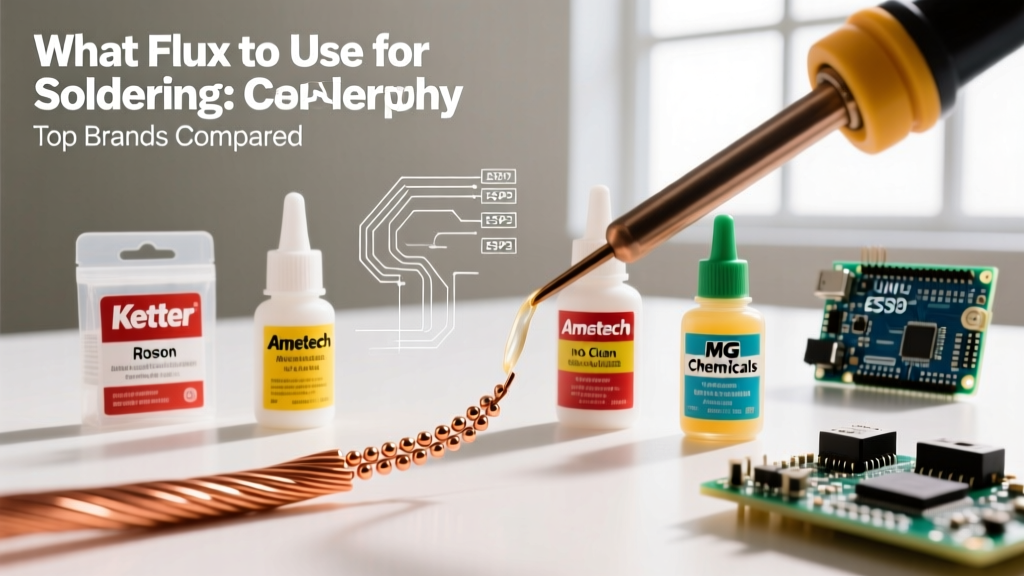

What Flux to Use for Soldering: Navigating the Top Brands in 2026
When building or repairing printed circuit boards (PCBs), asking what flux to use for soldering is just as critical as selecting the right soldering iron or wire alloy. Flux is the chemical agent that removes oxidation, promotes wetting, and prevents cold joints. However, the market is saturated with options ranging from $12 hobbyist bottles to $45 precision syringes. Choosing the wrong brand or chemical formulation can lead to catastrophic failure modes like electrochemical migration (dendritic growth) or hidden corrosion beneath ball grid arrays (BGAs).
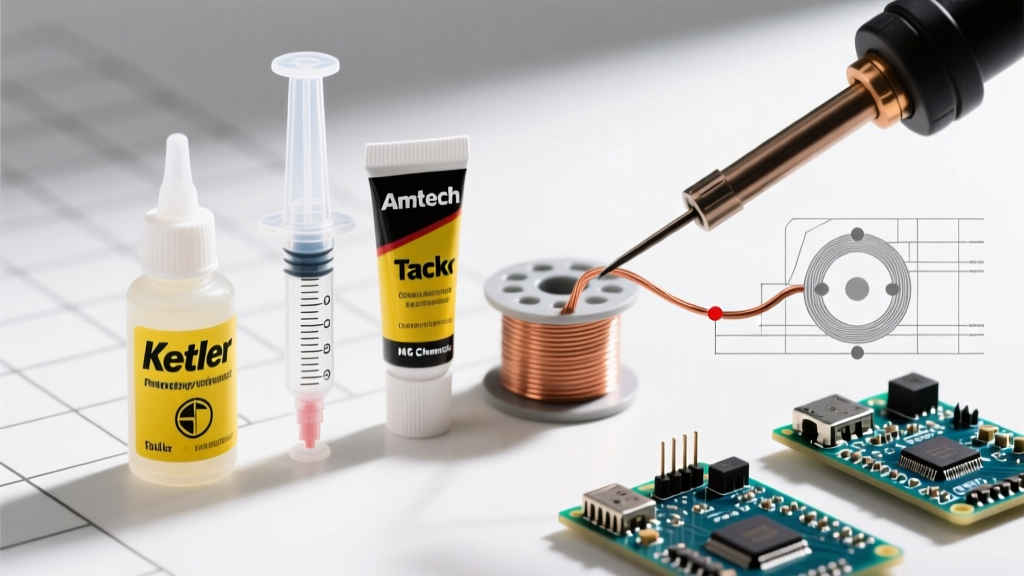
In this comprehensive brand comparison, we evaluate the industry titans—Kester, Amtech, MG Chemicals, and Chip Quik—to help you match the exact flux chemistry to your specific application, whether you are doing high-volume THT (Through-Hole Technology) assembly or microscopic SMD (Surface Mount Device) rework.
Decoding Flux Chemistry: The IPC J-STD-004 Standard
Before comparing brands, you must understand how flux is classified. According to the IPC J-STD-004 standard, fluxes are categorized by a four-character code indicating base material, activity level, and halide content. For example, ROL0 means Rosin base (RO), Low activity (L), and Zero halides (0). This standard is your roadmap for determining cleaning requirements and long-term reliability.
- ROL0 / REL0 (No-Clean): Leaves a safe, non-conductive residue. Ideal for modern SMD and BGA work where cleaning is impossible.
- ROM1 / REM1 (Rosin Mildly Activated): Excellent wetting for oxidized through-hole pads. Requires cleaning in high-reliability applications.
- ORH0 / ORG0 (Water-Soluble): Highly active organic acids. Provides brilliant, shiny joints but must be washed with DI (Deionized) water to prevent severe corrosion.
Brand 1: Kester (The Industry Standard)
Owned by MacDermid Alpha, Kester is the undisputed heavyweight in industrial electronics manufacturing. If you are looking for what flux to use for soldering in a professional or high-reliability environment, Kester is usually the default answer.
Flagship Products & Performance
- Kester 186 (RMA): A Rosin Mildly Activated liquid flux. It is legendary for through-hole and heavy wire tinning. It cuts through heavy oxidation effortlessly but leaves a sticky residue that requires isopropyl alcohol (IPA) or specialized saponifiers to clean.
- Kester 951 (No-Clean, ROL0): An ultra-low solids synthetic no-clean flux. It leaves virtually zero residue and is perfect for drag-soldering fine-pitch QFP (Quad Flat Package) chips. It will not cause short circuits, even if left uncleaned.
2026 Pricing: Expect to pay around $18 to $25 for a 100ml bottle of liquid flux, and upwards of $40 for specialized tack flux syringes. Kester is priced at a premium, but you are paying for batch-tested consistency and IPC compliance.
Brand 2: Amtech (The SMD & Paste King)
Amtech (now part of Indium Corporation) dominates the SMD rework and BGA reballing space. When technicians ask what flux to use for soldering microscopic components or reflowing BGA chips with hot air, Amtech is the most frequently recommended brand.
Flagship Products & Performance
- Amtech NC-559-V2-TF (Tack Flux): This is a no-clean, halide-free tack flux designed specifically to hold SMD components in place while providing excellent wetting during hot air rework. It has a high viscosity, preventing components from 'floating' or tombstoning when the solder melts.
- Amtech 4300 (Water-Soluble): Used in high-end manufacturing where post-solder aqueous cleaning is mandatory. It offers superior wetting on OSP (Organic Solderability Preservative) finishes.
2026 Pricing: Amtech syringes (10cc) typically range from $35 to $48. Warning: Amtech is heavily counterfeited online. Only purchase from authorized distributors like Digi-Key or Mouser to avoid fake flux that contains corrosive halides.
Brand 3: MG Chemicals (The Accessible All-Rounder)
MG Chemicals bridges the gap between industrial reliability and hobbyist accessibility. Their products are widely available on Amazon and local electronics stores, making them a go-to for prototyping labs and field repair technicians.
Flagship Products & Performance
- MG Chemicals 8341 (No-Clean): A highly effective ROL0 liquid flux. It flows beautifully under SMD chips via capillary action when applied with a precision needle. It leaves a clear, hard residue that does not interfere with multimeter probing.
- MG Chemicals 8342 (Water-Soluble): An organic acid flux that makes soldering to difficult surfaces like nickel or heavily oxidized copper a breeze. It must be cleaned with distilled water immediately after soldering.
2026 Pricing: Highly competitive. A 100ml bottle of MG 8341 or 8342 usually costs between $12 and $16. For educational labs and rapid prototyping, MG Chemicals offers the best price-to-performance ratio on the market.
Brand 4: Chip Quik (The Hobbyist & Prototyping Hero)
Chip Quik revolutionized DIY SMD soldering with their low-temperature alloys and user-friendly flux formulations. They focus heavily on the maker community and small-batch repair shops.
Flagship Products & Performance
- Chip Quik SMD291AX (No-Clean Tack Flux): A fantastic, budget-friendly alternative to Amtech for general SMD tack and rework. It has a slightly lower viscosity than Amtech, making it easier to dispense through fine needles without clogging.
- Chip Quik FLUX32 (Rosin Paste): A traditional rosin paste in a tub. Excellent for tinning stranded wires and soldering large mechanical connectors, though messy for fine-pitch PCB work.
2026 Pricing: SMD291AX (10cc syringe) retails for roughly $18 to $22. It is the most cost-effective entry point for high-quality SMD tack flux.
Head-to-Head Comparison Matrix
| Brand | Flagship Model | IPC Class | Best Application | 2026 Avg Price | Cleaning Required? |
|---|---|---|---|---|---|
| Kester | 951 Liquid | ROL0 (No-Clean) | Fine-pitch drag soldering | $22 / 100ml | No (Optional for aesthetics) |
| Amtech | NC-559-V2-TF | ROL0 (Tack) | BGA reballing, SMD rework | $42 / 10cc | No |
| MG Chemicals | 8342 Liquid | ORG0 (Water-Sol.) | Oxidized boards, heavy wire | $14 / 100ml | Yes (DI Water mandatory) |
| Chip Quik | SMD291AX | ROL0 (Tack) | General SMD prototyping | $19 / 10cc | No |
| Kester | 186 Liquid | ROM1 (RMA) | Through-hole, heavy tinning | $20 / 100ml | Yes (IPA or Saponifier) |
Critical Failure Modes: When the Wrong Flux Destroys Your PCB
Understanding what flux to use for soldering also means understanding what happens when you make the wrong choice. Here are three common failure modes observed in 2026 repair labs:
1. Electrochemical Migration (Dendritic Growth)
The Mistake: Using a water-soluble flux (like MG 8342 or Kester 245) on a dense BGA footprint and failing to clean it with heated deionized water.
The Result: The residual organic acids absorb ambient moisture. When voltage is applied, metal ions migrate between pads, forming microscopic metallic 'trees' (dendrites) that eventually cause a dead short. This failure can occur weeks or months after the board leaves the bench.
2. Solder Balling and Splattering
The Mistake: Using a low-solid, synthetic no-clean flux (like Kester 951) on heavily oxidized, old-school through-hole pads without pre-cleaning.
The Result: The flux lacks the chemical activators needed to penetrate thick oxidation layers. As the iron heats the pad, the solvent boils violently, causing microscopic solder balls to explode and lodge beneath nearby ICs, creating latent short circuits.
3. Tombstoning in SMD Assembly
The Mistake: Using a low-viscosity liquid flux instead of a high-viscosity tack flux (like Amtech NC-559) when hand-soldering 0402 or 0201 components.
The Result: Without the physical 'tack' holding the component down, the surface tension of the melting solder on one pad overpowers the other, flipping the component upright (tombstoning).
Expert Tip: Never mix flux chemistries. Applying a rosin-based flux over a water-soluble residue can trap the corrosive acids beneath a hardened rosin shell, making post-assembly cleaning impossible and guaranteeing long-term corrosion.
Decision Framework: Which Brand Should You Buy?
- For BGA Rework & Micro-SMD: Buy Amtech NC-559-V2-TF. The high tack and controlled wetting are worth the premium price for complex rework.
- For General PCB Prototyping & Drag Soldering: Buy Kester 951 or Chip Quik SMD291AX. Both offer excellent no-clean performance for everyday bench work.
- For Restoring Vintage Electronics & Heavy Wires: Buy Kester 186 or MG Chemicals 8342. The aggressive activators in these RMA and water-soluble formulas will cut through decades of grime and oxidation, provided you commit to cleaning the board afterward.
Final Thoughts
Ultimately, determining what flux to use for soldering comes down to your specific substrate, component density, and willingness to clean the board post-solder. By sticking to established, IPC-compliant brands like Kester, Amtech, and MG Chemicals, you eliminate the variable of chemical inconsistency. Invest in high-quality flux, store your syringes in a cool, dark place (or refrigerate them to extend shelf life), and your solder joints will remain reliable for decades. For deeper technical specifications on flux activity and halide limits, always refer to the official IPC Standards documentation or consult the technical data sheets provided by Kester and MG Chemicals.