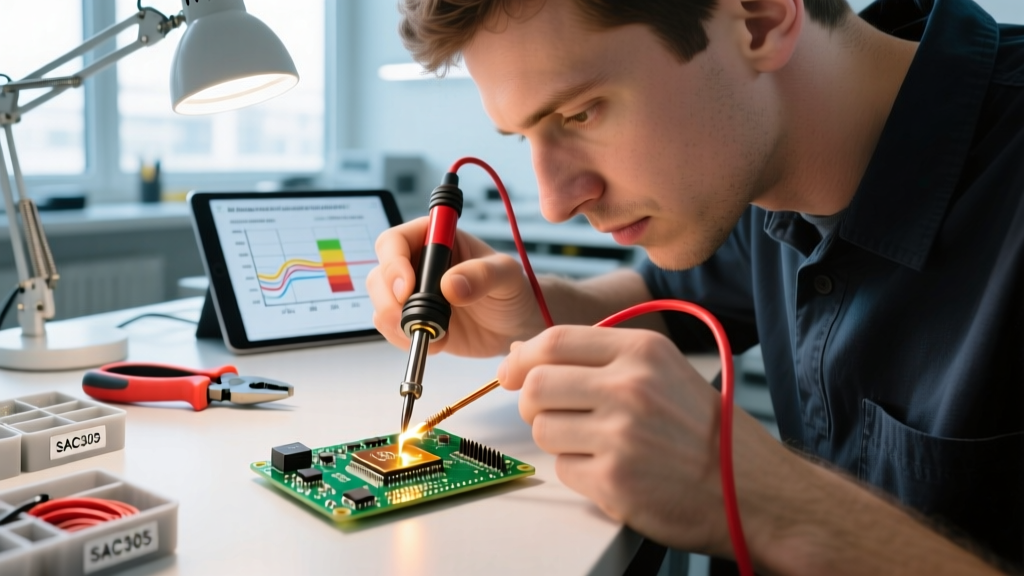

Introduction: The Metallurgical Reality of Hand Soldering
For the professional soldering worker, creating a reliable electrical and mechanical bond goes far beyond simply melting wire onto a pad. It requires a deep understanding of metallurgical compatibility, flux chemistry, and thermal dynamics. As we move through 2026, the industry's shift toward high-reliability lead-free assemblies and exotic substrate materials means that outdated 'one-size-fits-all' soldering approaches are a primary cause of field failures. Whether you are repairing legacy avionics, assembling high-density RF boards, or fabricating custom sensor arrays, matching your solder alloy and flux to the base metal is non-negotiable.
This guide provides the modern soldering worker with an actionable, data-driven framework for material compatibility, detailing exact alloy compositions, flux activators, and thermal thresholds required for defect-free intermetallic compound (IMC) formation.
The Base Metal and Alloy Compatibility Matrix
Not all metals accept solder equally. The solderability of a base metal is dictated by its oxidation rate and its ability to form a stable intermetallic layer with tin. Below is a quick-reference matrix for the most common materials encountered in electronics and electromechanical assembly.
| Base Metal | Solderability | Recommended Alloy (2026 Std) | Required Flux Type | Edge Cases & Warnings |
|---|---|---|---|---|
| Copper (Cu) | Excellent | SAC305 or Sn63Pb37 | RMA or No-Clean | Bare copper oxidizes rapidly; requires immediate fluxing after mechanical prep. |
| Brass (Cu/Zn) | Good | SAC305 or SN100C | RA (Rosin Activated) | High heat causes zinc migration, leading to porous, brittle joints. Keep dwell time under 3s. |
| Nickel (Ni) | Poor | SN100C (Sn99.3/Cu0.7/Ni) | RA or Water-Soluble | Nickel oxide is highly stable. Requires aggressive activators and higher tip temps (380°C+). |
| Stainless Steel | Very Poor | Sn60Pb40 (High wetting) | Inorganic Acid (Zinc Chloride) | Chromium oxide blocks wetting. NEVER use rosin. Mandatory post-solder hot DI water cleaning. |
| Beryllium Copper | Excellent | SAC305 or Indium-based | RMA or No-Clean | Safe to solder, but machining/sanding BeCu creates highly toxic dust. Solder only pre-cleaned parts. |
Flux Chemistry: Matching Activators to Oxides
The soldering worker must view flux not merely as a cleaning agent, but as a chemical catalyst designed to strip specific metal oxides. Choosing the wrong flux will result in cold joints, dendritic growth, or catastrophic corrosion.
Rosin-Based Fluxes (R, RMA, RA)
- R (Rosin): Pure pine sap derivative. Non-activated. Safe for highly sensitive PCBs but lacks the chemical muscle to penetrate anything beyond pristine gold or fresh copper.
- RMA (Rosin Mildly Activated): Contains mild halides or organic acids. The standard for general-purpose PCB assembly. Leaves a benign, non-conductive residue.
- RA (Rosin Activated): Heavily loaded with halide activators. Essential for soldering to nickel-plated connectors or slightly oxidized brass. Warning: RA residues are corrosive and hygroscopic; they must be cleaned with a saponifier or high-grade isopropyl alcohol (IPA) post-solder.
Water-Soluble and Inorganic Acid Fluxes
When the soldering worker transitions from PCBs to chassis grounding, RF shielding cans, or stainless steel hardware, rosin fails completely. Water-soluble organic acid (OA) fluxes and inorganic acid (IA) fluxes (containing zinc or ammonium chloride) are required. These fluxes chemically etch the chromium and nickel oxide layers. However, they mandate immediate post-solder cleaning with hot deionized (DI) water to halt the etching process and prevent galvanic corrosion.
Expert Insight on 'No-Clean' Fluxes: A common mistake in 2026 is attempting to clean 'No-Clean' flux residues with IPA. No-clean fluxes are engineered to encapsulate their activators in a hard, synthetic resin shell upon cooling. Scrubbing them with IPA breaks this shell, dissolving the activators and leaving a highly corrosive, conductive film on the board. If it is a true no-clean process, leave it alone; if it must be cleaned, use a specialized alkaline saponifier.
Advanced Material Challenges: Gold Embrittlement
Soldering to gold-plated surfaces presents a severe metallurgical trap. When standard tin-based alloys (like SAC305 or Sn63Pb37) contact gold, the gold rapidly dissolves into the molten solder, forming an intermetallic compound called AuSn4. This compound is notoriously brittle and migrates to the joint interface, causing catastrophic mechanical failure under thermal cycling or vibration.
The Soldering Worker's Solution:
- Gold Wash Removal: For gold layers thicker than 50 micro-inches, the worker must perform a 'tinning and wiping' procedure. Apply a fresh blob of solder to dissolve the gold, wipe it away with a brass wire sponge, and then solder the joint with fresh alloy.
- Indium-Based Alloys: For cryogenic, aerospace, or high-end RF applications where wiping is impossible, the worker must switch to Indium-based solders like Indalloy 121 (In51/Bi32.5/Sn16.5). Indium does not form brittle intermetallics with gold, ensuring a ductile, reliable joint. Note that Indalloy 121 melts at just 60°C, requiring specialized low-temp soldering irons.
Thermal Profiles and Substrate Protection
Material compatibility also extends to the thermal limits of the substrate. The soldering worker must balance the melting point of the alloy against the glass transition temperature (Tg) of the PCB or the thermal shock threshold of ceramics.
- Standard FR-4 (Tg 130°C - 170°C): When using SAC305 (melting at 217°C), set the iron tip to 350°C - 380°C. Maximum dwell time on a single pad should not exceed 4 seconds to prevent pad lifting and internal delamination.
- Heavy Ground Planes: Large copper pours act as massive heat sinks. Instead of turning the iron up to 450°C (which burns the flux and oxidizes the tip), the soldering worker should use a pre-heater to bring the entire board to 120°C, reducing the thermal delta and allowing a 380°C tip to flow the solder smoothly.
- Ceramic Substrates (Alumina/AlN): Used in high-power LED and RF amplifiers. Ceramics are highly susceptible to thermal shock. Applying a 400°C iron directly to a room-temperature ceramic substrate will cause micro-fractures. Mandatory board pre-heating to 100°C-130°C is required before localized soldering.
Occupational Safety and Hazardous Materials
According to guidelines published by the Occupational Safety and Health Administration (OSHA), the soldering worker must be protected from both chemical and particulate hazards. Colophony (rosin) fumes are a proven respiratory sensitizer and can induce occupational asthma. Local Exhaust Ventilation (LEV) systems must capture fumes within 2 inches of the soldering iron tip; overhead fans merely blow the sensitizers across the worker's face and are strictly non-compliant.
Furthermore, the IPC (Association Connecting Electronics Industries) standards dictate strict handling protocols for legacy and exotic materials. Never apply heat to cadmium-plated components, as cadmium oxide fumes are acutely toxic. When handling Beryllium Copper (BeCu) springs or connectors, ensure the material has not been recently machined or sanded in-house without proper wet-extraction, as beryllium dust causes chronic beryllium disease (CBD). Soldering itself on pre-manufactured, cleaned BeCu is safe, provided standard rosin fume extraction is utilized.
Actionable Workflow for Soldering Unknown Metals
When a soldering worker is tasked with repairing a legacy device or joining an unidentified alloy, follow this empirical workflow to ensure compatibility and joint integrity:
- Mechanical Prep: Abrade the surface lightly with fiberglass scratch pen or fine scotch-brite to remove heavy corrosion. Do not use sandpaper on potentially toxic alloys (like BeCu).
- Flux Test: Apply a mild RMA flux and attempt to wet the surface with Sn63Pb37 at 350°C. If the solder balls up and refuses to wet, the metal has a stable oxide layer (likely stainless, nickel, or aluminum).
- Escalate Activators: Clean the area and apply a water-soluble organic acid flux. Re-attempt wetting. If successful, the joint can be completed, but the board must be cleaned in an ultrasonic DI water bath immediately.
- Aluminum Rejection: If water-soluble flux fails, you are likely dealing with aluminum or a high-zinc die-cast. Standard soldering is impossible. The worker must pivot to mechanical fastening, conductive epoxies, or specialized ultrasonic soldering equipment.
Conclusion
The mark of an expert soldering worker in 2026 is not just a steady hand, but a deep, diagnostic understanding of the materials on the workbench. By matching the correct flux activator to the base metal oxide, selecting alloys that prevent intermetallic embrittlement, and respecting the thermal limits of modern substrates, you ensure assemblies that survive both the test bench and the real world. For further reading on advanced assembly requirements, consult the NASA Electronic Parts and Packaging (NEPP) Program archives, which remain the gold standard for extreme-reliability soldering protocols.