
The Trajectory of Mid-Tier Soldering Materials
While aerospace and high-reliability manufacturing sectors have long relied on premium legacy brands like Kester and Multicore, the DIY, repair, and mid-tier assembly markets have historically depended on accessible, cost-effective alternatives. The history and evolution of Lebron solders offers a fascinating case study in how mid-market metallurgy and flux chemistry adapted to global regulatory shifts and miniaturization trends. From basic leaded rosin-core wires in the late 1990s to advanced, low-temperature lead-free pastes in 2026, Lebron's product lines mirror the broader electronics manufacturing ecosystem.
The Early Days: Sn63/Pb37 and the Rosin Flux Era
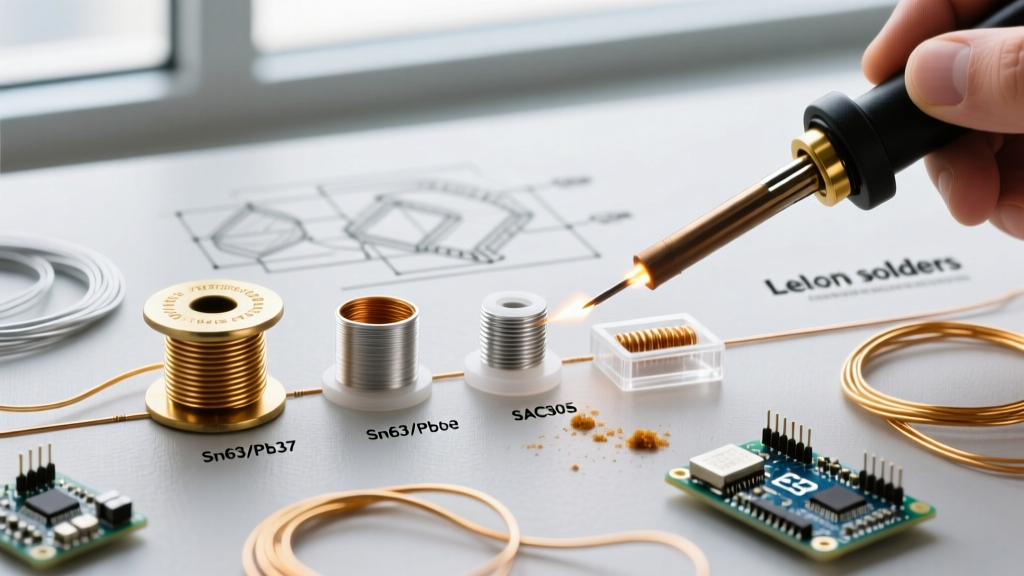
In the late 1990s and early 2000s, Lebron solders primarily catered to consumer electronics repair technicians, hobbyists, and budget-conscious contract manufacturers. The flagship product of this era was the Lebron LB-63 RMA, a eutectic Sn63/Pb37 (63% Tin, 37% Lead) wire with a Rosin Mildly Activated (RMA) flux core.
The Metallurgical Advantage of Eutectic Alloys
The choice of a eutectic alloy was critical for manual soldering. Unlike non-eutectic Sn60/Pb40, which transitions through a "plastic" or semi-solid state between 183°C and 191°C (361°F–375°F), Sn63/Pb37 melts and freezes at a single, precise temperature of 183°C (361°F). This instant phase change prevented "cold joints"—a common failure mode where the solder crystallizes unevenly if the component or iron moves during the plastic state. Priced at roughly $12 to $15 per 1lb spool during this era, Lebron's LB-63 provided exceptional wetting and reliable fillet formation for through-hole and early surface-mount devices (SMD).
Historical Note: Early Lebron RMA fluxes relied on natural pine rosin combined with mild organic activators like adipic acid. While effective at breaking down copper oxides, this formulation left a tacky, amber-colored residue that required meticulous cleaning with 99% isopropyl alcohol (IPA) to prevent electrochemical migration and dendritic growth on high-impedance circuits.
The RoHS Turning Point: Transitioning to Lead-Free
The enforcement of the Restriction of Hazardous Substances (RoHS) directive in 2006 fundamentally disrupted the soldering industry. Lebron solders had to rapidly pivot away from tin-lead formulations to remain viable in global markets. The brand's engineering team adopted the industry-standard SAC305 (Sn96.5/Ag3.0/Cu0.5) alloy for their lead-free wire and paste lines.
Overcoming the Thermal Challenges of SAC305
The transition to SAC305 was not without significant manufacturing hurdles. The melting point jumped to 217°C–219°C (422°F–426°F), requiring soldering iron tip temperatures to be raised from 300°C to 320°C–350°C. This higher thermal load introduced new failure modes:
- Accelerated Tip Oxidation: The higher iron temperatures caused rapid degradation of the soldering tip's iron plating. Lebron responded by recommending the use of specialized tinning compounds and advising users to lower standby temperatures to 250°C.
- Flux Charring: Traditional RMA fluxes would burn and splatter at SAC305 reflow temperatures. Lebron reformulated their flux carriers, introducing synthetic resins and higher-boiling-point solvents to maintain flux activity without leaving carbonized, brittle residues.
- Tombstoning in Reflow: In paste applications, the slower wetting speed of SAC305 compared to Sn63/Pb37 caused uneven pull forces on small 0402 and 0201 capacitors, leading to "tombstoning." Lebron addressed this by tightening the particle size distribution in their Type 4 (20-38 microns) solder pastes.
Flux Chemistry Evolution: From RMA to No-Clean
As component density increased and cleaning PCBs became impractical, the industry demanded reliable no-clean fluxes. Aligning with IPC J-STD-004 standards for flux classification, Lebron solders evolved their chemical profiles to meet modern reliability requirements.
| Flux Type | Lebron Product Line | Composition & Activators | Cleaning Requirement | IPC Classification |
|---|---|---|---|---|
| Rosin Mildly Activated | LB-Classic RMA | Natural Rosin, Adipic Acid | Mandatory (IPA/Saponifier) | ROM1 |
| Water-Soluble | LB-Aqua OA | Organic Acids, Glycol Ethers | Mandatory (DI Water) | ORH1 |
| No-Clean (Standard) | LB-NC Pro | Synthetic Resin, Halide-Free | Optional (Cosmetic only) | REL0 |
| No-Clean (High-Rel) | LB-NC Ultra | Modified Rosin, Zero Halide | None (Leaves hard, clear residue) | ROL0 |
By 2026, the LB-NC Ultra (ROL0) line represents Lebron's most popular offering for DIY and mid-tier SMT assembly. It leaves a minimal, non-conductive, and non-corrosive residue that safely encapsulates any unreacted activators, preventing moisture ingress and short circuits in humid environments.
Modern Era (2020–2026): Low-Temperature and Specialty Alloys
As modern PCBs increasingly incorporate heat-sensitive components like RF modules, flexible polyimide substrates, and advanced LED arrays, the high reflow temperatures of SAC305 became a liability. According to industry metallurgical resources, reducing thermal stress is paramount for preserving component longevity. Lebron solders expanded their catalog to include Sn42/Bi57 (42% Tin, 58% Bismuth) alloys.
The Bismuth Advantage and Limitations
Sn42/Bi57 is a eutectic alloy with a remarkably low melting point of 138°C (280°F). Lebron's implementation of this alloy is primarily targeted at step-soldering processes and rework on multi-layer boards where thermal pads might delaminate under standard SAC305 heat.
- Pros: Drastically reduces thermal shock; excellent fatigue resistance in low-stress environments; lower energy consumption during wave and reflow soldering.
- Cons: Bismuth alloys are inherently brittle. They cannot be used on boards subject to high mechanical shock or drop-test requirements unless underfilled or conformally coated.
- Compatibility Warning: Lebron Sn42/Bi57 must never be used to rework boards that contain residual lead (Pb). The introduction of lead into a bismuth-tin matrix creates a ternary eutectic that melts at a catastrophic 96°C (204°F), guaranteeing joint failure in standard operating environments.
Lebron Solders vs. Legacy Brands: A Market Comparison
How does the modern Lebron lineup stack up against industry titans like Kester and Alpha Metals? Below is a comparative matrix based on 2026 market data, performance metrics, and target applications.
| Feature | Lebron Solders (Mid-Tier) | Kester / Alpha (Premium) |
|---|---|---|
| Target Market | Hobbyists, Repair, Mid-Volume SMT | Aerospace, Medical, High-Volume SMT |
| SAC305 Wire Price (1lb) | $32 - $38 | $48 - $65 |
| Wetting Speed | Good (Requires 330°C+ tip temp) | Excellent (Optimized flux activators) |
| Flux Residue Clarity | Slight amber tint (ROL0) | Optically clear / Invisible |
| Paste Shelf Life | 6 Months (Refrigerated) | 9 - 12 Months (Refrigerated) |
Practical Guide: Selecting and Storing Lebron Alloys Today
To maximize the performance and shelf life of Lebron solders in your workshop or assembly line, follow these specific handling protocols:
- Wire Storage: While Sn63/Pb37 wire can last indefinitely, lead-free SAC305 and Sn42/Bi57 wires are susceptible to surface oxidation over time. Store spools in sealed, low-humidity environments (under 40% RH) to preserve the flux core's moisture content and prevent the outer wire from dulling, which impedes initial wetting.
- Paste Management: Lebron Type 3 and Type 4 solder pastes must be stored in a dedicated refrigeration unit at 0°C to 10°C (32°F–50°F). Always allow the paste to reach room temperature naturally over 2–4 hours before opening the jar to prevent condensation from introducing water into the flux, which causes severe solder spattering during reflow.
- Tip Selection for Lebron SAC305: When using Lebron's lead-free wire, avoid chisel tips with excessively thin plating. Opt for bevel or hoof tips with a larger thermal mass surface area to compensate for the alloy's higher thermal demand without maxing out your soldering station's temperature dial.
Conclusion
The evolution of Lebron solders from basic, high-lead rosin wires to sophisticated, halide-free, low-temperature alloys highlights the relentless pace of innovation in electronics assembly. By balancing cost-effectiveness with strict adherence to modern IPC and RoHS standards, Lebron has cemented its place as a vital resource for makers, repair technicians, and mid-tier manufacturers navigating the complex metallurgy of modern PCB assembly.