
Defining the Soldering Icon: More Than Just a Brand
In the world of electronics assembly and DIY repair, a 'soldering icon' is not merely a popular product; it is a tool that fundamentally shifts how technicians approach thermal management and joint reliability. Over the last five decades, the evolution of the soldering icon has mirrored the broader trajectory of electronic miniaturization. As components shrank from massive through-hole capacitors to microscopic 0201 surface-mount devices (SMD), the tools used to attach them had to evolve from brute-force thermal mass to precision-engineered, closed-loop microcontrollers.
Understanding this history is not just an academic exercise. For modern buyers in 2026, knowing why legacy stations failed at specific tasks reveals exactly why modern architectures—like integrated heater cartridges and RISC-V smart irons—dominate the market today. This guide traces the lineage of the most iconic soldering stations and provides a data-driven framework for selecting the right tool for your workbench.
The Analog Legends: Weller WES51 and Hakko 936
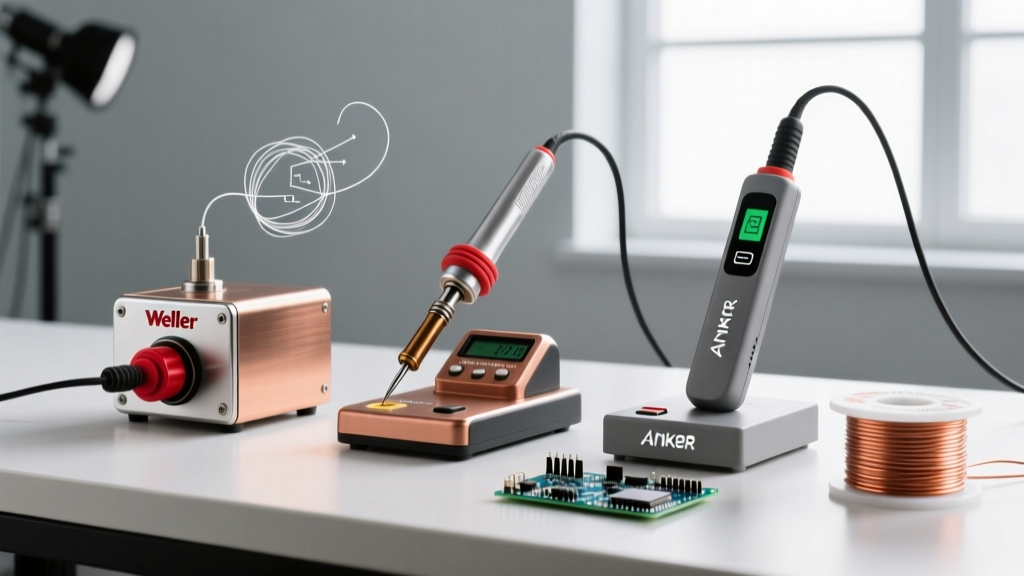
Before the advent of digital displays and USB-C power delivery, the workbench was ruled by two undisputed icons: the Weller WES51 and the Hakko 936. Introduced in the late 1970s and 1980s respectively, these stations established the baseline for what a professional soldering iron should be.
The Weller WES51: The ETA Pioneer
The Weller WES51 became an industry staple due to its Energy Transfer (ETA) tip technology. Unlike previous irons that relied on a separate heating element and a rudimentary thermocouple, the WES51 embedded the sensor directly into the tip's copper core. This provided a 50-watt analog output with relatively fast thermal recovery for its time. However, its failure mode was well-known among production technicians: the analog dial lacked precise temperature readouts, and the physical gap between the heating element and the tip sleeve caused thermal lag when touching heavy copper ground planes.
The Hakko 936: The ESD-Safe Challenger
Hakko responded with the 936, an icon in its own right, which introduced a ceramic heating element and robust ESD (Electrostatic Discharge) safe grounding. Priced aggressively (historically around $80 to $100), it became the default icon for university labs and hobbyists. Yet, the ceramic heater's fragility and the slow heat-up time of over 45 seconds highlighted the physical limitations of separating the heater from the tip.
'The transition from analog dial stations to digital readouts in the early 2000s wasn't just about aesthetics; it was driven by the strict thermal profiling requirements outlined in early revisions of the IPC J-STD-001 standards, which demanded verifiable temperature controls for high-reliability assemblies.' — IPC J-STD-001 Soldering Standards Overview
The High-Frequency Disruption: Metcal and Curie Physics
In the 1990s, as multi-layer PCBs with massive thermal sinks became common, standard resistive heaters struggled to maintain temperature. Enter Metcal, a brand that redefined the high-end soldering icon through RF induction heating.
Metcal stations (like the legendary SP200) eliminated the thermocouple entirely. Instead, they passed a 13.56 MHz radio frequency current through a coil in the handpiece, inducing eddy currents in a ferromagnetic alloy core inside the tip. When the tip reached its specific Curie temperature, the core lost its magnetic properties, halting the induction process instantly. This self-regulating physics loop meant zero calibration was ever required, and thermal recovery was nearly instantaneous. While the $400+ entry price kept it out of hobbyist hands, Metcal became the undisputed icon for aerospace and high-volume production environments.
The Modern Era: Cartridge Systems and Smart Irons
The 2010s and 2020s brought two massive paradigm shifts that created the modern soldering icons we use today: the integrated cartridge and the open-source smart iron.
JBC and the Cartridge Revolution
Spanish manufacturer JBC completely reimagined the handpiece by integrating the heater, sensor, and tip into a single, disposable cartridge (the C245 and C115 series). Because the heating element is literally inside the tip cavity, the thermal path is reduced to millimeters. A JBC CD-2BQF station can heat a C245 cartridge from room temperature to 350°C in under 2 seconds. This extreme responsiveness makes JBC the current icon for advanced SMD rework and micro-soldering, though the proprietary cartridges cost between $45 and $60 each, locking users into an expensive ecosystem.
Pinecil V2 and the USB-C Smart Iron
On the opposite end of the spectrum, the maker community birthed a new type of icon: the open-source, firmware-flashable smart iron. The Pine64 Pinecil V2 disrupted the market by packing a Bouffalo Lab BL706 RISC-V microcontroller into a stick smaller than a marker. Powered by any standard 65W USB-C PD (Power Delivery) laptop charger, it offers PID temperature control, custom boot logos, and firmware updates for roughly $26. It proved that a modern soldering icon doesn't need a heavy transformer base; it just needs smart power negotiation and efficient FET-driven resistive heating.
Comparison Matrix: Legacy vs. Modern Soldering Icons
| Era / Archetype | Iconic Model | Heating Technology | Recovery Time (to 350°C) | Approx. 2026 Market Price |
|---|---|---|---|---|
| Analog Resistive | Weller WES51 | Nichrome / ETA Tip | ~40-50 seconds | $120 (Used/NOS) |
| Ceramic ESD | Hakko FX-888D | Ceramic Element / T18 Tip | ~30 seconds | $110 |
| RF Induction | Metcal SP200 | 13.56 MHz Curie Induction | ~8 seconds | $450+ |
| Integrated Cartridge | JBC CD-2BQF (C245) | Internal Cartridge Heater | < 2 seconds | $425 (Station) |
| USB-C Smart Iron | Pine64 Pinecil V2 | RISC-V PID / DC FET | ~6-8 seconds (at 65W) | $26 (Iron only) |
2026 Buyer's Framework: Which Icon Belongs on Your Bench?
Selecting the right tool requires matching the technology to your specific thermal loads and budget. Use this decision matrix to guide your purchase:
- The Weekend Tinkerer & Field Tech (Budget: $25 - $60): Buy the Pinecil V2 or Miniware TS101. Pair it with a high-quality 65W or 100W GaN USB-C wall charger. This setup is unbeatable for portability, and the rapid firmware updates ensure compatibility with the latest PD 3.1 protocols.
- The Generalist Hobbyist & Repair Tech (Budget: $100 - $150): The Hakko FX-888D remains a reliable, low-maintenance workhorse. Tip availability is universal, and the T18 tips cost less than $5 each. It is the safest bet for general through-hole and basic 0805 SMD work.
- The Micro-Soldering & SMD Rework Pro (Budget: $400+): Invest in a JBC station (e.g., CD-2BQF). When working under a microscope on 0.3mm pitch BGA pads or repairing smartphone flex cables, the 2-second thermal recovery and ultra-low thermal mass of the C115/C245 cartridges prevent collateral heat damage to adjacent plastic connectors.
FAQ: Maintaining Your Soldering Gear
Why do my smart iron tips burn out faster than my old Weller tips?
Smart irons like the Pinecil heat up so rapidly that users often leave them at 400°C+ out of habit. High temperatures accelerate tip oxidation and flux carbonization. Always utilize the 'sleep mode' or 'standby temperature' feature (set to 150°C) in your iron's firmware menu to extend tip life by up to 300%.
Are JBC cartridges worth the $50 price tag?
For production or high-stakes micro-rework, yes. The JBC Cartridge System Technology ensures that the heater never degrades separately from the tip. When a tip wears out, you are replacing the entire thermal engine, guaranteeing factory-spec performance on every swap. For general wiring, however, the cost is prohibitive.
Can I use any USB-C charger with modern smart irons?
No. Modern smart irons require chargers that support USB-C Power Delivery (PD) and can negotiate 20V at 3.25A (65W) or higher. If you plug a Pinecil V2 into a standard 5V/2A phone brick, it will cap out at 10W, rendering it useless for anything larger than 24AWG wire. Always verify the charger's PDO (Power Data Object) output ratings before purchasing.