
The Case for Mobile Micro-Climate Mapping
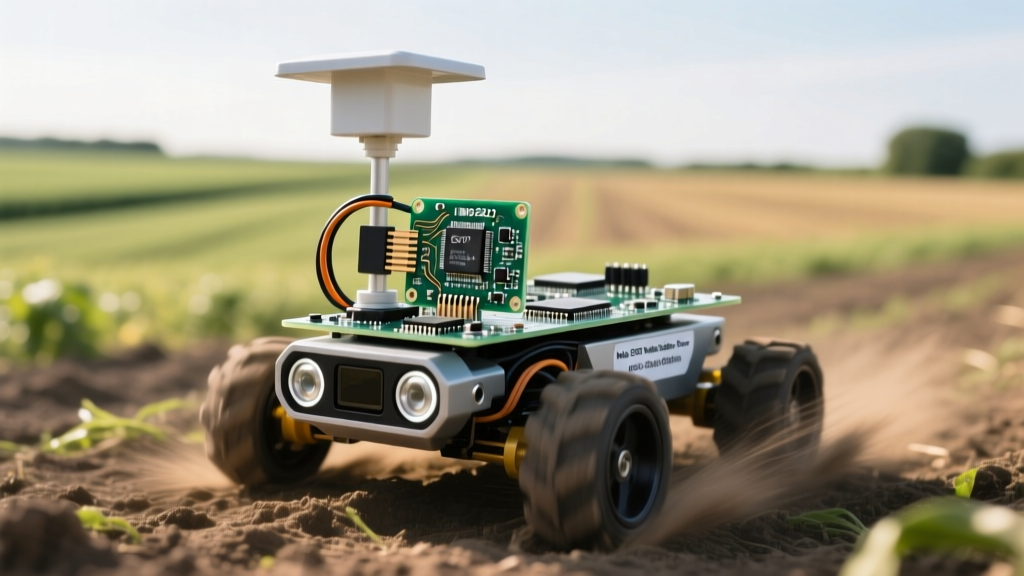
Static weather stations are fundamentally limited. In large-scale greenhouse operations or expansive permaculture farms, a single fixed sensor cannot capture the thermal gradients and humidity pockets that dictate plant health or robotic navigation traction. By mounting an ESP32 weather station onto an autonomous 4WD rover chassis, engineers can generate dynamic, 3D micro-climate heat maps. This robotics build moves beyond basic IoT projects, integrating environmental sensing with mobile kinematics and ROS 2 (Robot Operating System) telemetry.
Hardware Bill of Materials (BOM) & Pricing
Designing a mobile sensor node requires balancing power consumption, processing overhead, and mechanical durability. Below is the optimized BOM for a heavy-duty agricultural rover.
| Component | Model / Specification | Est. Price | Role in System |
|---|---|---|---|
| Microcontroller | ESP32-WROOM-32U (with U.FL antenna) | $6.50 | Core processing & Wi-Fi/UDP telemetry |
| Env. Sensor | Bosch BME280 (I2C Breakout) | $7.00 | Temp, Humidity, Barometric Pressure |
| Motor Driver | TB6612FNG Dual H-Bridge | $4.50 | Drivetrain control (high efficiency) |
| Chassis | 4WD Acrylic Rover w/ TT Motors (130 RPM) | $22.00 | Mobility and payload carrying |
| Power | 3S 11.1V 2200mAh LiPo + UBEC (5V/3A) | $35.00 | Isolated logic and motor power |
Sensor Selection: Why BME280 Over DHT22?
Many entry-level tutorials default to the DHT22 for ESP32 weather stations. For a mobile robotics application, the DHT22 is a critical point of failure. The DHT22 uses a single-bus digital protocol that is highly susceptible to timing interrupts caused by Wi-Fi transmission and motor PWM signals. Furthermore, the DHT22's exposed capacitive humidity element degrades rapidly when exposed to agricultural condensation. The Bosch BME280, communicating via a dedicated I2C bus, offers hardware-level clock stretching, 24-bit pressure resolution, and a much higher tolerance to environmental stress.
Mechanical Assembly & The PETG Stevenson Screen
A weather station is only as accurate as its shielding. Direct sunlight will skew temperature readings by up to 8°C, and soil splash from rover tires will destroy the humidity sensor. You must enclose the BME280 in a Stevenson Screen—a louvered enclosure that allows passive airflow while blocking direct radiation.
Robotics Pro-Tip: Do not use PLA filament to 3D print your mobile Stevenson Screen. Inside a closed greenhouse, ambient temperatures can exceed 55°C, causing PLA to warp and collapse the louvers. Print the enclosure in PETG or ASA, and mount it at least 25cm above the rover chassis to avoid thermal radiation from the TT motors and motor driver.
Wiring the ESP32 Weather Station to the Rover Drivetrain
Integrating environmental sensors with high-torque drivetrains introduces severe electrical noise. The TB6612FNG motor driver is chosen over the older L298N because its MOSFET-based design generates significantly less electromagnetic interference (EMI) and operates with a lower voltage drop.
- BME280 VCC: ESP32 3.3V (Do not use 5V, the onboard LDO will overheat in direct sun)
- BME280 GND: ESP32 GND
- BME280 SCL: ESP32 GPIO 22
- BME280 SDA: ESP32 GPIO 21
- TB6612FNG PWMA/B: ESP32 GPIO 18, 19 (Hardware PWM pins)
Mitigating Motor EMI and I2C Bus Lockups
The most common failure mode in mobile ESP32 weather stations is the I2C bus locking up due to voltage spikes from the TT motors. When the rover stops or changes direction, the inductive kickback from the motors can induce noise on the 3.3V logic rail, causing the ESP32 to miss an I2C acknowledgment and crash. To solve this, you must implement two hardware fixes:
- Decoupling Capacitors: Solder 100nF ceramic capacitors directly across the terminals of each of the four TT motors. This shorts high-frequency brush noise before it reaches the main wiring harness.
- Isolated Power Rails: Use a 5V/3A UBEC (Battery Eliminator Circuit) to power the ESP32 and sensor logic directly from the LiPo. Do not share the 5V rail with the motor driver's logic supply.
For deeper insights on stabilizing ESP32 I2C networks, refer to the wiring guides at Random Nerd Tutorials.
Firmware: Publishing to ROS 2 via Micro-ROS
In a modern robotics stack, the ESP32 acts as a sensor node rather than a standalone web server. Using Micro-ROS, the ESP32 weather station publishes data directly to a ROS 2 network running on a central Raspberry Pi 4 or Nvidia Jetson rover brain. This allows the robot's navigation stack (Nav2) to dynamically adjust its path planning based on localized humidity data (e.g., avoiding muddy, high-humidity zones that could cause wheel slip).
The firmware initializes the BME280 at a 1Hz sampling rate, packages the data into sensor_msgs/msg/Temperature and sensor_msgs/msg/FluidPressure messages, and transmits them via UDP over the farm's Wi-Fi mesh network. UDP is preferred over TCP in mobile robotics to prevent network latency spikes from blocking the rover's real-time control loops.
Field Testing & Common Failure Modes
Deploying a mobile ESP32 weather station in the field reveals edge cases that bench testing misses. Below is a troubleshooting matrix based on real-world agricultural deployments:
- Sensor reads 99% Humidity constantly: The BME280 membrane is saturated with agricultural condensation. Fix: Implement a software-controlled heating cycle (the BME280 supports internal heater registers) to bake off condensation every 4 hours.
- ESP32 Random Reboots on Carpet/Grass: High-friction surfaces cause TT motors to draw stall currents exceeding 1A, sagging the battery voltage and triggering the ESP32's brownout detector (BOD). Fix: Lower the BOD threshold in the ESP32's RTC control registers via the Arduino IDE, or upgrade to a higher C-rating LiPo battery.
- Wi-Fi Disconnects in Greenhouse Aisles: Water in plant tissue absorbs 2.4GHz Wi-Fi signals. Fix: Switch the ESP32-WROOM-32U to an external 5dBi omnidirectional antenna via the U.FL connector, and configure the router to use Channel 1 to minimize overlap with neighboring farm equipment.
Building a mobile ESP32 weather station bridges the gap between static IoT monitoring and autonomous robotics. By addressing EMI, thermal shielding, and ROS integration, you transform a simple microcontroller project into an industrial-grade agricultural data gathering platform.