
The Core Concept: Why Microcontrollers Need a USB Host
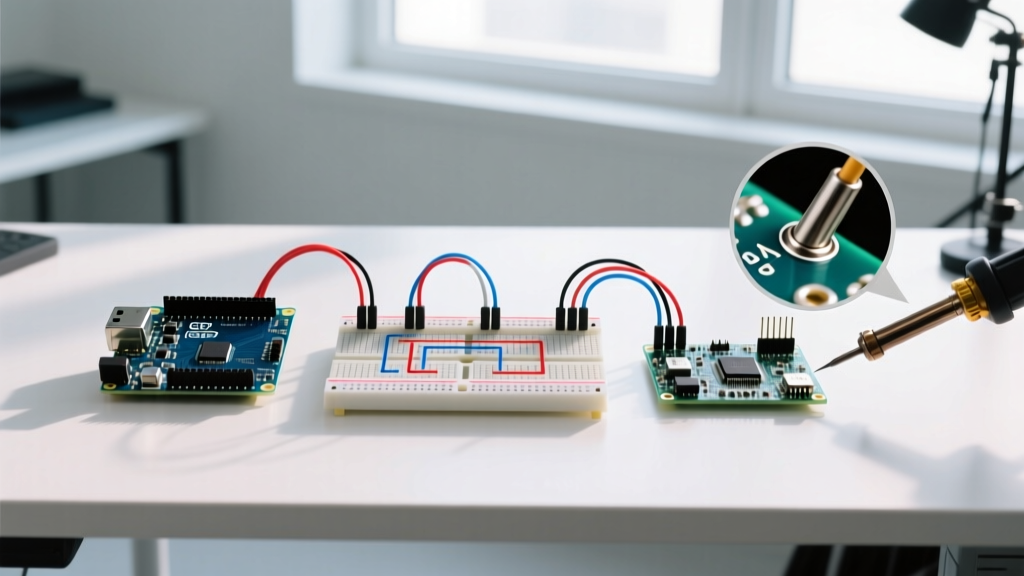
When most makers begin working with microcontrollers, they quickly learn how to connect sensors, displays, and motors. However, integrating standard USB peripherals—like a PC keyboard, a barcode scanner, or a FAT32 flash drive—presents a fundamental architectural hurdle. By default, the classic Arduino Uno and Mega act as USB devices (or rely on a bridge chip like the ATmega16U2 to communicate with a PC). They cannot natively act as a USB host to poll, enumerate, and read data from external USB peripherals.
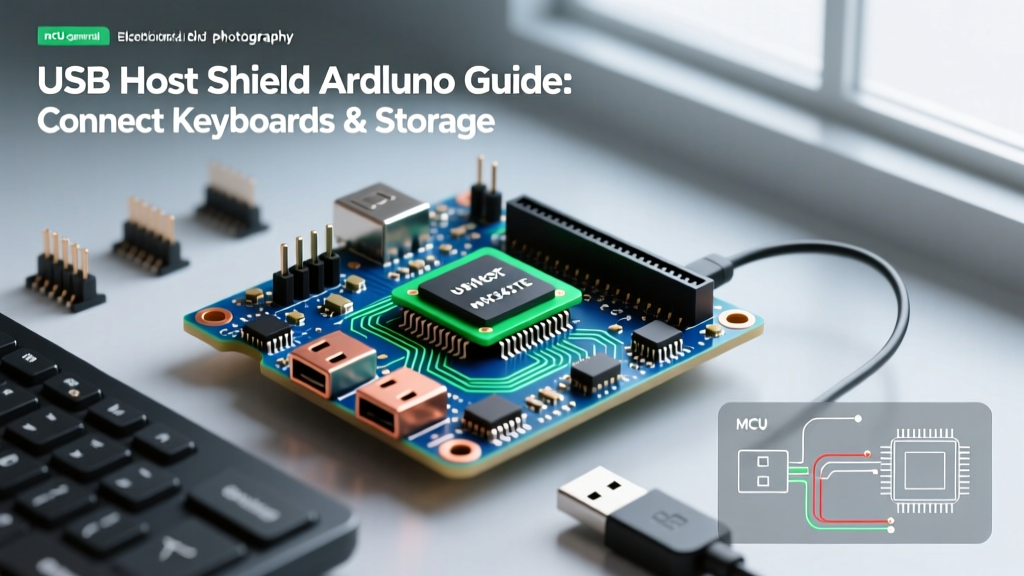
This is exactly where the USB Host Shield Arduino integration comes into play. By stacking a dedicated USB host controller onto your microcontroller, you bypass the ATmega's native limitations. The shield essentially acts as a bridge, translating complex USB bus protocols into simple SPI (Serial Peripheral Interface) commands that the Arduino can easily digest. Whether you are building a custom retro-gaming console, an industrial data-logging terminal, or a robotics control interface, understanding this hardware is critical for expanding your I/O capabilities.
Inside the Hardware: The MAX3421E Controller
The heart of the USB Host Shield is the MAX3421E USB host/peripheral controller, originally designed by Maxim Integrated (now Analog Devices). This chip handles the heavy lifting of USB protocol management, including bus enumeration, token generation, and data packet framing. Because the ATmega328P lacks the hardware MAC layer and processing overhead to manage USB 1.1/2.0 Low-Speed (1.5 Mbps) and Full-Speed (12 Mbps) traffic natively, the MAX3421E offloads this burden.
The MAX3421E communicates with the Arduino via the SPI bus. According to the official Arduino SPI reference, this requires a master-slave configuration where the Arduino acts as the SPI Master and the MAX3421E acts as the Slave. The chip operates internally at 3.3V, meaning the shield incorporates logic level shifters (typically BSS138 MOSFETs or 74LVC245 ICs) to safely interface with 5V logic boards like the Uno and Mega.
SPI Pin Mapping and Interrupt Routing
Proper SPI routing is the most common point of failure for beginners. The shield utilizes hardware SPI pins, which differ depending on your board's architecture. Furthermore, the MAX3421E requires a dedicated hardware interrupt pin to signal the microcontroller when a USB event (like a device connection or data packet receipt) occurs.
| Signal | Arduino Uno / Pro (ATmega328P) | Arduino Mega 2560 | Function |
|---|---|---|---|
| SS (CS) | D10 | D53 | SPI Slave Select |
| MOSI | D11 | D51 | Master Out, Slave In |
| MISO | D12 | D50 | Master In, Slave Out |
| SCK | D13 | D52 | SPI Clock |
| INT | D9 | D9 | Hardware Interrupt |
Power Delivery: The 500mA Bottleneck
A critical, often overlooked aspect of the USB Host Shield Arduino setup is power budgeting. The USB specification mandates that a standard downstream port must supply up to 500mA at 5V. The shield features a standard USB Type-A receptacle, but it does not have its own dedicated voltage regulator. Instead, it draws 5V directly from the Arduino's 5V pin.
Expert Warning: If you are powering your Arduino Uno via a standard PC USB port (limited to 500mA) and plug a 300mA mechanical keyboard into the shield, you risk brownout resets or damaging the Arduino's onboard polyfuse. Always use the Arduino's DC barrel jack with a 7V-12V power supply when hosting power-hungry peripherals.
For industrial applications or when using high-draw peripherals like external hard drives or unpowered USB hubs, you must bypass the Arduino's power rail entirely. Many premium shields include a terminal block or a solder jumper to inject 5V directly into the shield's VBUS line. In 2026, clone shields from manufacturers like Keyestudio or Deek-Robot (typically priced between $12 and $18) often omit this terminal block, requiring you to manually solder a 5V feed to the VBUS pad on the MAX3421E breakout if you exceed the ATmega's thermal limits.
Software Stack: The USB_Host_Shield_2.0 Library
Hardware is only half the battle. To parse the complex USB descriptors, you need a robust software stack. The undisputed standard for this hardware is the USB_Host_Shield_2.0 library, originally developed by Oleg Mazurov and currently maintained by the open-source community under the 'felis' repository.
This library abstracts the low-level SPI register reads and writes into high-level C++ classes. It supports several vital USB device classes:
- HID (Human Interface Device): Supports boot-protocol keyboards, mice, and generic gamepads. Excellent for building custom macro pads or robotic joysticks.
- Mass Storage Class (MSC): Allows reading and writing to FAT16/FAT32 formatted USB thumb drives using the standard Arduino SD library wrapper.
- CDC/ACM (Communication Device Class): Enables the Arduino to talk to USB-to-Serial adapters, GPS modules, or 3D printer mainboards via virtual COM ports.
- PTP (Picture Transfer Protocol): Used for triggering and pulling data from older digital cameras (though largely superseded by MTP in modern devices).
Initialization and The Main Loop
Unlike standard sensor libraries that simply read a pin, the USB host stack requires continuous polling. The MAX3421E handles the physical layer, but the Arduino must call Usb.Task() inside the main loop() to process state machines, handle enumeration, and dispatch data to your application logic. Failing to call this function frequently enough (or blocking the loop with delay()) will result in dropped packets and device disconnections.
Real-World Failure Modes and Troubleshooting
Even with perfect wiring, USB is a notoriously finicky protocol. Below are the most common edge cases encountered when deploying the USB Host Shield Arduino configuration in the field, along with their solutions.
| Failure Symptom | Root Cause | Engineering Solution |
|---|---|---|
| Shield initializes, but device enumeration fails (Error 0xD1 or 0xFF). | Insufficient current or voltage drop across the shield's PTC resettable fuse. | Inject external 5V directly to the shield's VBUS pad; ensure the power supply can deliver at least 1.5A. |
| Intermittent SPI communication errors; serial monitor prints garbage. | SPI bus contention or lack of level shifting on 3.3V MCUs (e.g., Arduino Due or Teensy). | Modify the shield to bypass the 5V-to-3.3V logic shifters, or use a dedicated 3.3V MCU with native 3.3V SPI. |
| Arduino resets randomly when plugging in a peripheral. | USB Hub backfeeding or massive inrush current tripping the Arduino's onboard 500mA polyfuse. | Avoid unpowered hubs; add a 1000µF electrolytic capacitor across the shield's 5V and GND rails to buffer inrush spikes. |
| Keyboard connects but outputs random/missing characters. | USB interrupt pin (D9) not configured correctly or blocked by timer libraries. | Ensure no other libraries (like Servo or specific PWM timers) are overriding Hardware Interrupt 0 (INT0 on D2/D9 depending on board). |
The 2026 Landscape: Shield vs. Native USB OTG
While the USB Host Shield Arduino stack remains a vital tool for retrofitting legacy ATmega-based systems, the maker ecosystem in 2026 has largely shifted toward microcontrollers with native USB OTG (On-The-Go) capabilities. Boards like the ESP32-S3 and the Raspberry Pi Pico (RP2040) feature hardware USB MAC layers built directly into the silicon.
For a new project requiring USB host functionality, an ESP32-S3 DevKitC (costing around $8) is often a more elegant, cost-effective solution than an Arduino Uno ($25) plus a USB Host Shield ($15). The ESP32-S3 can act as a host natively using the TinyUSB stack, saving board space, reducing SPI overhead, and lowering overall power consumption.
However, the USB Host Shield remains irreplaceable in specific scenarios: industrial environments where certified ATmega-based PLCs are already deployed, educational settings teaching SPI bus architectures, and robotics projects where the main MCU's pins are entirely saturated and SPI is the only available bus. Furthermore, the original hardware documentation by Circuits@Home remains one of the best open-source references for understanding USB state machines at the register level.
Frequently Asked Questions
Can I use a USB hub with the Arduino Host Shield?
Yes, but with caveats. The MAX3421E supports hub enumeration, but you must use a powered USB hub. Unpowered hubs will attempt to draw current for all connected devices through the shield's single 500mA PTC fuse, leading to immediate brownouts.
Does the shield support USB audio or webcams?
No. The MAX3421E and the ATmega328P lack the bandwidth and RAM required to handle USB Isochronous transfers, which are necessary for streaming audio or video data. The shield is strictly limited to Interrupt, Control, and Bulk transfer types (HID, Storage, Serial).
Why is my flash drive not recognized?
The USB_Host_Shield_2.0 Mass Storage driver only supports FAT16 and FAT32 file systems. If your drive is formatted as exFAT or NTFS (common for drives over 32GB), the Arduino will fail to mount the partition. Reformat the drive to FAT32 using a third-party partition manager.