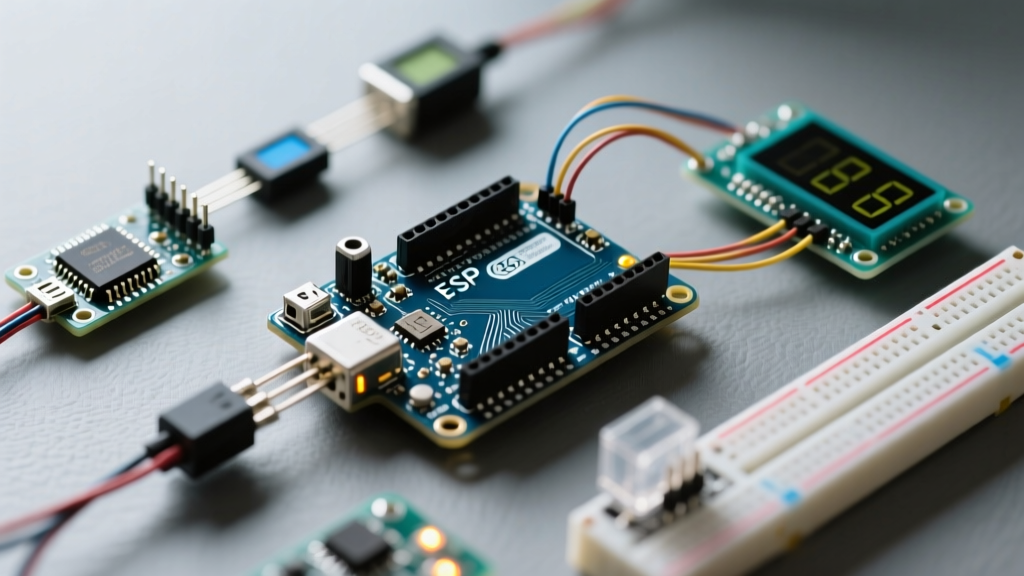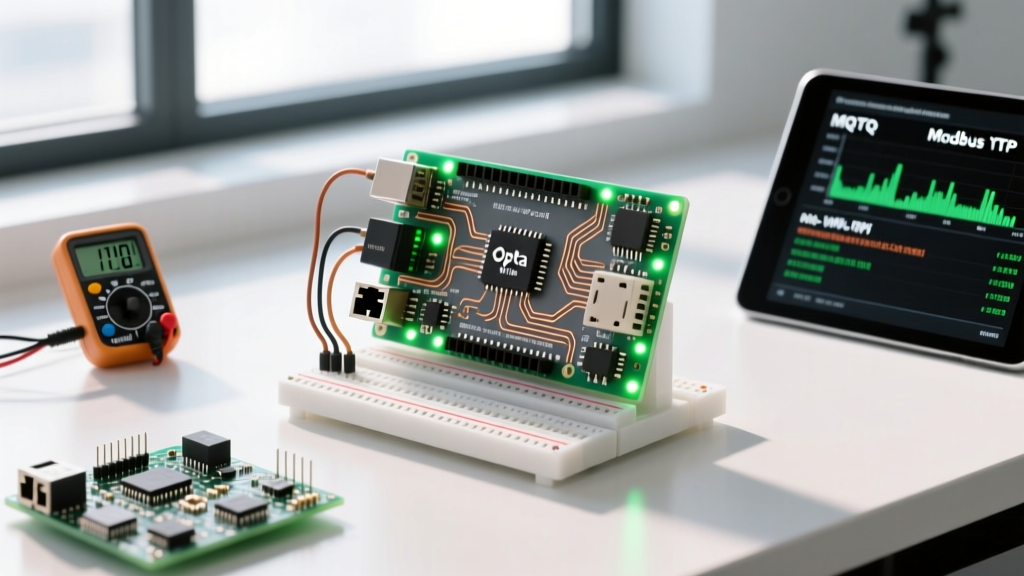

Bridging the OT/IT Divide: The Arduino Opta WiFi as a Protocol Gateway
In the modern industrial automation landscape, the boundary between Operational Technology (OT) and Information Technology (IT) has completely dissolved. Factory floor sensors must now communicate seamlessly with cloud dashboards, edge AI models, and enterprise resource planning (ERP) systems. Enter the Arduino Opta WiFi (SKU: AFX00003), a micro PLC that retails for approximately $235 USD. Unlike traditional compact PLCs that require expensive, bolt-on communication modules to achieve secure cloud connectivity, the Opta WiFi integrates a dual-core STM32H747XI microcontroller and a Murata 1DX Wi-Fi/Bluetooth module directly onto the PCB.
This article provides a deep-dive protocol explainer on how the Arduino Opta WiFi handles the 'Big Three' industrial protocols: Modbus TCP, MQTT, and OPC UA. We will explore the hardware architecture that makes this possible, memory management strategies, and real-world edge cases you will encounter in 2026 IIoT deployments.
The Dual-Core Architecture: Why It Matters for Networking
To understand how the Opta WiFi handles heavy protocol encryption without dropping I/O scans, you must understand its asymmetric multicore processing. According to the official Arduino Opta hardware documentation, the device utilizes an STMicroelectronics STM32H747XI chip.
- Cortex-M4 Core (240 MHz): Dedicated to deterministic, real-time IEC 61131-3 PLC logic (ladder diagram, function block). It scans the 8 analog/digital inputs and 4 relay outputs with microsecond precision.
- Cortex-M7 Core (480 MHz): Handles the lwIP TCP/IP stack, the Murata 1DX WiFi driver, and heavy cryptographic workloads via its hardware crypto accelerator.
1. Modbus TCP: The OT Workhorse
Modbus TCP remains the undisputed king of legacy field device communication. The Modbus Application Protocol Specification defines how registers are mapped over standard TCP/IP networks. The Opta WiFi can act as both a Modbus TCP Server (allowing a central SCADA system to poll its I/O) and a Modbus TCP Client (polling external VFDs or smart meters).
Implementation & Edge Cases
Using the ArduinoModbus library, configuring the Opta as a TCP server is straightforward. However, industrial environments introduce severe electrical noise and network congestion.
- Register Mapping: Map your 8 analog inputs to Holding Registers (addresses 40001-40008). Use 32-bit floating-point mapping (spanning two registers per value) for precision sensor data like 4-20mA pressure transducers.
- Polling Edge Case: If a SCADA system polls the Opta WiFi faster than 20ms per transaction over a congested 2.4 GHz WiFi band, the lwIP stack's TCP receive buffers can overflow. Implement a transaction rate-limiter in your M7 core firmware to queue and throttle incoming Modbus requests.
- Coil vs. Register: Use Coils (00001-00004) strictly for the 4 physical relay outputs. Do not use Coils for internal boolean logic states; use Discrete Inputs or internal Holding Register bit-masking instead to prevent accidental overwrites from rogue SCADA clients.
2. MQTT: The IT and Cloud Bridge
While Modbus speaks to the factory floor, MQTT speaks to the cloud. MQTT's publish/subscribe model is ideal for the Opta WiFi's bandwidth-constrained Murata 1DX module, which operates exclusively on the 2.4 GHz 802.11 b/g/n bands.
TLS Encryption and the M7 Crypto Accelerator
In 2026, transmitting unencrypted telemetry to AWS IoT Core or Azure IoT Hub is a severe security violation. MQTT over TLS (port 8883) requires X.509 certificate validation and AES-GCM encryption. On a standard 8-bit or entry-level 32-bit MCU, a TLS handshake can take 3-5 seconds, freezing the application.
The Opta WiFi solves this via the STM32H7's dedicated hardware cryptographic accelerator. The M7 core handles the mbedTLS library operations, completing handshakes in under 400ms.
Pro-Tip for MQTT Payloads: Avoid sending raw JSON strings generated viaStringconcatenation. The STM32H747XI has 1MB of SRAM, but heap fragmentation from dynamic string allocation will eventually cause a hard fault. Use statically allocated buffers and libraries likeArduinoJsonwith pre-sizedJsonDocumentobjects to serialize telemetry payloads.
3. OPC UA: The Industrial Standard
OPC UA (Unified Architecture) is the gold standard for secure, platform-independent industrial data exchange. The OPC Foundation designs it to handle complex data modeling, not just raw register values. Running an OPC UA server on a micro PLC was virtually impossible a few years ago due to the massive RAM footprint of the address space.
Running a Lightweight OPC UA Server on the Opta
Arduino provides a lightweight OPC UA server stack optimized for the Opta. It allows you to expose your PLC variables as nodes in a standardized namespace.
- Namespace Indexing: Define a custom namespace URI (e.g.,
urn:electricalflux:opta:cell1) to avoid collisions with the standard OPC Foundation namespace. - Node ID Mapping: Map critical variables (like motor temperature or emergency stop states) to specific NodeIds. Use semantic naming rather than numeric IDs to ensure MES (Manufacturing Execution Systems) can auto-discover your data models.
- Memory Constraints: The Opta's 8MB QSPI Flash stores the OPC UA stack and certificates, while the 1MB SRAM holds the active node tree. Limit your custom address space to under 150 nodes to ensure the M7 core has sufficient heap memory for incoming secure channel requests.
Protocol Comparison Matrix
| Protocol | Primary Use Case | Opta Core Assignment | Overhead & Latency |
|---|---|---|---|
| Modbus TCP | Legacy SCADA, VFDs, Smart Meters | M7 (Network) / M4 (Data Source) | Low overhead, ~10-20ms latency |
| MQTT (TLS) | Cloud Telemetry, Remote Dashboards | M7 (TLS & TCP/IP Stack) | High initial handshake, low steady-state |
| OPC UA | MES Integration, Complex Data Modeling | M7 (Server Stack & Encryption) | High RAM overhead, moderate latency |
Troubleshooting Network Edge Cases in the Field
Deploying the Arduino Opta WiFi inside a NEMA-rated electrical panel introduces unique RF and thermal challenges. Here is how to handle the most common failure modes:
1. WiFi Dropout and MQTT Reconnect Loops
Metal enclosures act as Faraday cages. If the Opta loses connection to the 2.4 GHz access point, a poorly written MQTT client will immediately attempt to reconnect, flooding the MCU's TCP stack and causing a watchdog reset.
The Fix: Implement an exponential backoff algorithm. Start with a 2-second delay between reconnect attempts, doubling it up to a maximum of 60 seconds. Furthermore, utilize the STM32's Independent Watchdog (IWDG) set to a 4-second timeout. If the M7 core locks up during a failed DNS resolution, the IWDG will trigger a clean hardware reset.
2. TLS Handshake Failures on Expired Certificates
The Opta lacks a persistent Real-Time Clock (RTC) battery on the main board (it relies on an external supercapacitor or network time). If the device reboots and the time is incorrect, TLS certificate validation will fail immediately.
The Fix: Always implement an NTP (Network Time Protocol) sync routine on the M7 core immediately after WiFi association and before initiating any MQTT or OPC UA TLS handshakes. Use a pool like pool.ntp.org and verify the epoch timestamp is greater than your certificate's 'Not Before' date.
Conclusion
The Arduino Opta WiFi is not just a prototyping board; it is a highly capable, $235 industrial micro PLC that punches far above its weight class. By intelligently leveraging its dual-core STM32H7 architecture, engineers can run deterministic IEC 61131-3 logic on the M4 core while simultaneously serving Modbus TCP, publishing encrypted MQTT telemetry, and hosting an OPC UA address space on the M7 core. Understanding the memory boundaries and network stack behaviors of these protocols is the key to deploying robust, maintenance-free IIoT nodes in 2026 and beyond.