
The 2026 Supply Chain Reality: A Catalyst for Engineering Mastery
If you have tried to source a specific STM32F103C8T6 microcontroller, a TI TPS5430 buck converter, or even basic 74HC-series logic ICs recently, you already know the frustration. While the post-pandemic semiconductor crisis has eased for generic passives and basic diodes, the shortage of electronic components in 2026 remains a harsh reality for specialized power management ICs, automotive-grade sensors, and high-end ADCs. Lead times for allocated parts still hover between 30 and 52 weeks, and gray-market scalpers often mark up $2 ICs to $45.
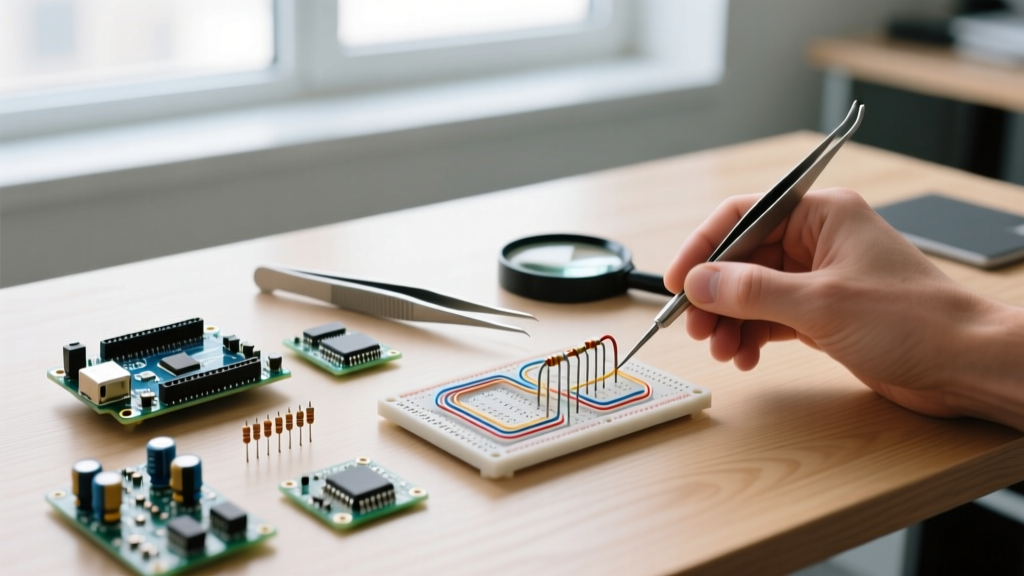
For the DIY electronics enthusiast, this environment is not a roadblock; it is a masterclass. Relying solely on pre-packaged ICs makes you an assembler, not an engineer. The true Skill-Building Path involves using the current supply chain constraints to force yourself back to the fundamentals: discrete component design, advanced PCB rework, and precision e-waste harvesting. Here is how to turn the shortage of electronic components into your greatest technical advantage.
Phase 1: Mastering Discrete Substitution (The 'No-IC' Approach)
When a specific integrated circuit is on backorder, the immediate instinct is to hunt for a pin-compatible alternative. Instead, use this as an opportunity to design the functionality from scratch using discrete transistors, op-amps, and passives. According to the foundational All About Circuits Semiconductor Textbook, understanding the building blocks of ICs drastically improves your ability to troubleshoot and optimize complex circuits.
Case Study: Building an Astable Multivibrator
Suppose you need a simple 1kHz clock signal, but the NE555 timers in your local distributor's inventory are allocated. You can build a highly stable astable multivibrator using two general-purpose NPN BJTs (like the ubiquitous 2N3904 or BC547).
- The Math: The frequency formula for a symmetrical astable multivibrator is roughly
f = 1 / (1.386 * R * C). - The Build: To achieve ~1kHz, use 10kΩ base resistors and 100nF coupling capacitors. Power it with a clean 5V rail.
- Failure Mode & Edge Case: If the circuit fails to oscillate on power-up, it is usually due to the beta ($h_{FE}$) of the specific transistor batch being too low to saturate, or parasitic capacitance on a breadboard choking the high-frequency edges. Solution: Add 100Ω emitter resistors to stabilize the bias point, or switch to a Darlington pair configuration for higher gain.
By mastering discrete logic, you immunize yourself against the shortage of electronic components in the logic and timing domains. You also gain a profound understanding of propagation delay and thermal drift that IC datasheets often obscure.
Phase 2: Advanced Salvage and E-Waste Harvesting
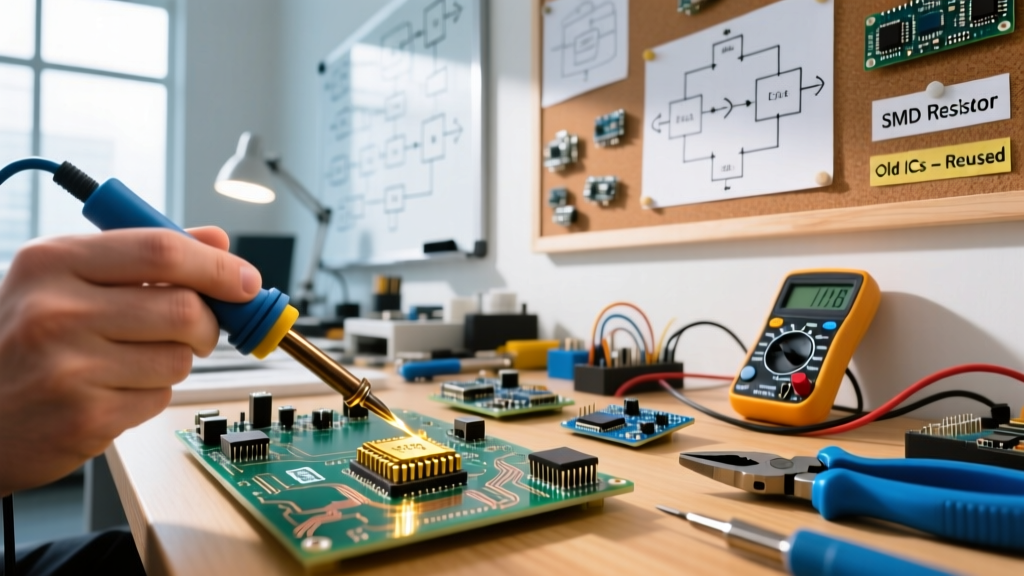
The secondary market is flooded with dead PC motherboards, broken server PSUs, and discarded telecom equipment. These are goldmines for high-quality SOIC-8 op-amps, SOT-23 MOSFETs, and ceramic capacitors. However, harvesting SMD components without destroying the silicon or lifting the PCB pads requires strict thermal management.
The Professional Harvesting Workflow
To safely extract components, you need more than just a soldering iron. Invest in a precision hot air rework station like the Quick 861DW (typically priced around $235–$250 in 2026) and a high-quality, no-clean tacky flux such as Amtech NC-559-V2-TF (ensure you buy from authorized distributors to avoid counterfeit fluxes that cause dendrite growth).
- Preheat the Board: Never apply 350°C air directly to a cold, multi-layer ground plane. Use a bottom preheater (or a heat gun on the underside) to bring the ambient PCB temperature to 120°C–150°C. This prevents the 'tombstone' effect and pad delamination.
- Apply Flux Generously: Flood the target IC pins. Flux lowers the surface tension of the solder and ensures even heat distribution across all pins simultaneously.
- Hot Air Parameters: Set the Quick 861DW to 360°C with an airflow of 35-40. Use a nozzle that slightly overlaps the IC body. Keep the wand moving in small circles.
- The Lift: When the solder liquefies, the component will 'float' and self-center due to surface tension. Use vacuum pickup tweezers to lift it straight up. Never drag or pry with metal spudgers, which will gouge the FR4 substrate.
Pro-Tip: Adhere to the IPC-7711/7721 Rework Standard guidelines for thermal profiling. Exceeding 260°C on the component body for more than 10 seconds can permanently alter the internal doping characteristics of semiconductors, leading to latent failures in your DIY projects.
Phase 3: PCB Rework and Footprint Adaptation
You designed a custom PCB, sent it to the fab house, and assembled your BOM. But wait—the specific SOIC-14 logic IC you designed for is out of stock globally, and only the TSSOP-14 (a much narrower footprint) is available. Do you scrap the boards? No. You adapt.
The 'Dead Bug' and Wire-Wrap Technique
Footprint adaptation is a critical skill when navigating the shortage of electronic components. When forced to mount a smaller IC onto larger pads, or an entirely different package:
- Use 30 AWG Kynar Wire: This wire-wrap wire has a fluoropolymer insulation that will not melt or shrink back when touched by a 350°C iron. It is perfect for 'flying wires' between mismatched pads.
- The Dead Bug Method: Flip the IC upside down (legs in the air) and glue it to the PCB using a tiny drop of UV-curable solder mask (like MG Chemicals 419D). Solder your 30 AWG wires directly from the IC legs to the PCB pads.
- Strain Relief: Once soldered, encapsulate the entire wire-web in two-part epoxy or a generous glob of UV resin. This prevents mechanical vibration from fatiguing the micro-solder joints.
The 2026 Substitution & Skill Matrix
Use this matrix to identify which missing components offer the highest ROI for your skill-building path.
| Unavailable Component | Discrete / Alternative Solution | Core Skill Developed | Difficulty |
|---|---|---|---|
| NE555 Timer IC | 2x 2N3904 BJTs, 4x Resistors, 2x Caps | Analog timing, transistor saturation | Beginner |
| LM7805 Linear Regulator | Zener Diode + NPN Power Transistor (TIP31) | Thermal dissipation, feedback loops | Intermediate |
| Specific SOIC-8 Op-Amp | Harvested Op-Amp via Hot Air Rework | SMD rework, IPC thermal standards | Intermediate |
| Dedicated H-Bridge IC | 4x Logic-Level MOSFETs (IRLZ44N) + Gate Drivers | Shoot-through prevention, gate capacitance | Advanced |
Shifting Your Mindset for Long-Term Resilience
Industry analysts tracking the Octopart Market Insights Blog frequently note that the era of 'just-in-time' component availability for niche semiconductors is likely gone forever. Geopolitical friction, fab consolidation, and the surge in AI-driven hardware demand mean that the shortage of electronic components will remain a cyclical, persistent challenge throughout the late 2020s.
By embracing the Skill-Building Path, you stop being a victim of supply chain logistics. Every time an IC is out of stock, you are presented with a mandatory training exercise in discrete physics, thermal dynamics, and mechanical adaptation. Stock up on 30 AWG Kynar wire, calibrate your hot air station, and start viewing empty Digi-Key inventory pages not as a delay, but as your syllabus for the week.