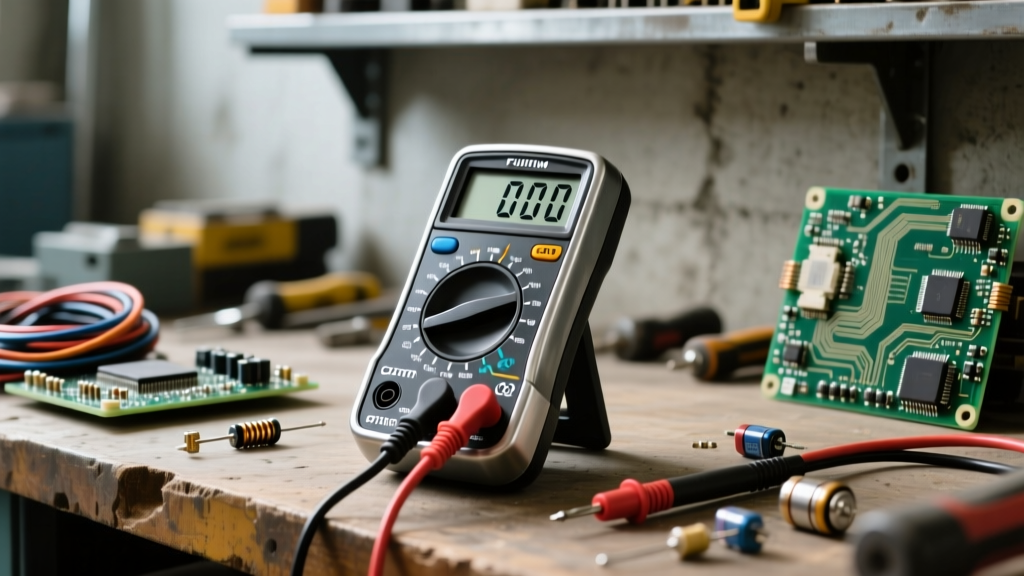

The Core Anatomy of an Electrician's Multimeter
When tackling residential or commercial DIY wiring, the tools you use dictate not just the success of your project, but your physical safety. A hobbyist electronics meter designed for testing 5V Arduino logic or 12V car batteries is fundamentally different from a professional multimeter for electrician use. The primary differentiator is internal input protection and transient voltage handling.
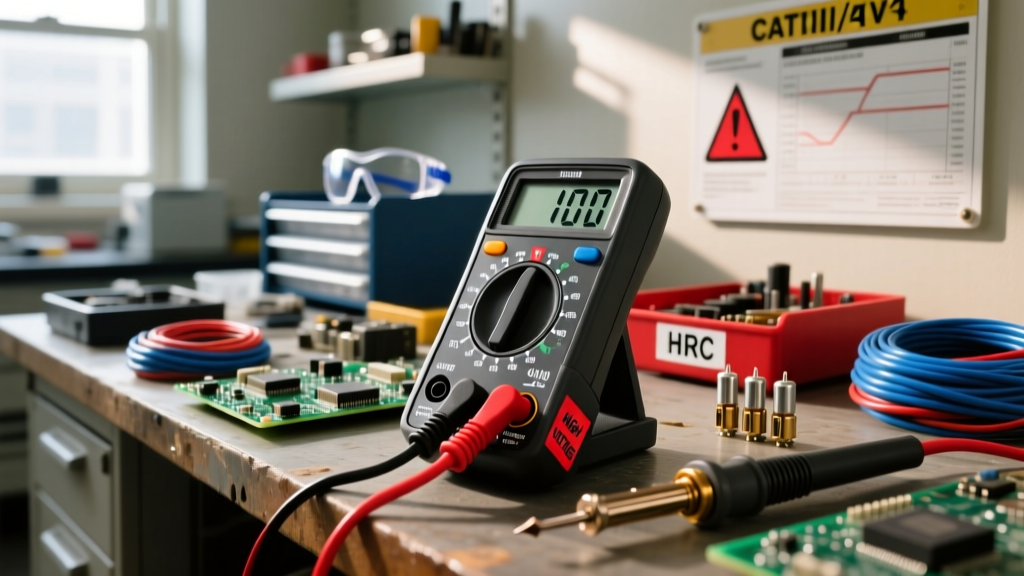
Inside a professional-grade meter, you will find High Rupturing Capacity (HRC) fuses. Unlike the cheap glass fuses found in budget meters, HRC fuses are housed in ceramic tubes filled with special arc-quenching sand. If you accidentally test a 480V industrial circuit while the meter is set to the current (Amps) mode, a glass fuse will vaporize, potentially causing an arc flash that destroys the meter and injures the user. An HRC fuse safely contains the explosive energy, sacrificing itself to protect you.
Decoding Safety Categories: Why CAT III and CAT IV Matter
The International Electrotechnical Commission (IEC) establishes safety categories (CAT ratings) based on the measurement environment's potential for dangerous transient overvoltages. According to OSHA Electrical Safety guidelines, understanding these environments is critical for preventing fatal shocks.
- CAT II: Single-phase receptacle connected loads (appliances, portable tools).
- CAT III: Three-phase distribution, fixed motors, lighting systems, and the main service panel in a residential home.
- CAT IV: The origin of the installation (utility meters, primary overcurrent protection, outdoor service entrance).
Safety Warning: Never use a CAT II rated meter to test a main breaker panel. A lightning strike or utility grid switching event can induce a transient spike of several thousand volts. A CAT III 600V or CAT IV 300V rated meter is engineered with internal air gaps and surge resistors to safely bleed off these spikes without arcing across the circuit board.
Real-World Failure Modes: What Happens When You Guess?
The most common failure mode for DIYers is using an unrated or under-rated meter on a 240V split-phase panel. If moisture or conductive dust has accumulated inside a cheap meter, a high-voltage transient can track across the PCB, creating a short circuit. This results in the meter literally exploding in the user's hands. Always verify the CAT rating printed near the input jacks, not just on the front display.
Essential Features for Residential and Commercial Wiring
Beyond basic safety, a reliable multimeter for electrician tasks must include specific diagnostic features that solve common field problems.
Low Impedance (LoZ) Mode
Ghost voltage is a frequent nuisance in DIY wiring. When unenergized wires run parallel to live wires inside a conduit or Romex cable, capacitive coupling can induce a 'phantom' voltage of 30V to 90V on the dead wire. Standard high-impedance digital multimeters (which draw almost zero current) will read this ghost voltage, leading to dangerous misdiagnoses. A LoZ mode introduces a low-impedance load to the circuit, bleeding off the capacitive coupling and revealing the true zero-voltage state of the dead wire.
True RMS vs. Average Responding
If you are only testing basic incandescent lighting or resistive heaters, an average-responding meter is fine. However, modern homes are filled with non-linear loads: LED drivers, variable frequency drives (VFDs) on HVAC motors, and computer power supplies. These devices distort the AC sine wave. A True RMS (Root Mean Square) meter accurately calculates the heating value of these distorted waveforms, whereas an average-responding meter can be off by up to 40%, leading to undersized wire and breaker trips.
Market Contenders: Fluke vs. Klein vs. Brymen
Choosing the right tool requires balancing budget, safety, and feature sets. Below is a comparison of three industry-standard models frequently used by professionals and serious DIYers.
| Model | Safety Rating | Key Feature | Approx. Price | Best Application |
|---|---|---|---|---|
| Fluke 117 | CAT III 600V | VoltAlert NCV & AutoVolt | $210.00 | Residential troubleshooting & quick panel checks |
| Brymen BM235 | CAT III 600V / CAT IV 300V | LoZ, True RMS, High Precision | $115.00 | Advanced DIYers needing CAT IV origin testing |
| Klein Tools MM700 | CAT III 600V | True RMS, Rugged Build | $65.00 | Budget-conscious DIYers doing standard receptacle wiring |
The Fluke 117 remains the gold standard for electricians due to its non-contact voltage (NCV) sensor built directly into the tip, allowing you to verify the presence of voltage before even touching bare copper. The Brymen BM235 offers incredible value, providing CAT IV protection and LoZ at nearly half the price of the Fluke, making it a favorite among advanced hobbyists. For those just starting their DIY journey, the Klein MM700 provides reliable True RMS measurements and robust drop protection, as noted in the Klein Tools Multimeter catalog.
Step-by-Step: Testing a 240V Split-Phase Dryer Receptacle
To put your multimeter for electrician use to the test, let us walk through verifying a NEMA 14-30R receptacle, commonly used for electric dryers and EV chargers. This requires strict adherence to NFPA 70E electrical safety standards regarding PPE and safe work practices.
- Visual Inspection: Ensure your test leads are rated CAT III 1000V / CAT IV 600V and have no exposed copper along the shafts. Wear safety glasses and insulated gloves.
- Verify the Meter: Test your multimeter on a known live 120V source to confirm it is functioning correctly before testing the target circuit.
- Test Line-to-Line (L1 to L2): Insert the probes into the two hot slots (usually the angled top and bottom slots). The reading should be between 238V and 242V.
- Test Line-to-Neutral (L1 to N & L2 to N): Move one probe to the neutral slot (the straight vertical slot). You should read 119V to 121V on both hot legs.
- Test Neutral-to-Ground (N to G): Place probes on the neutral and the grounding pin (the U-shaped or round pin). This should read less than 1.5V. A higher reading indicates a loose neutral connection at the main panel, which is a severe fire hazard.
Maintenance and Calibration Realities
Even the best multimeter requires basic maintenance to remain safe. The most overlooked failure point in DIY toolboxes is battery leakage. Alkaline batteries left inside a meter for years will corrode the battery contacts and seep acid onto the main PCB, destroying the rotary switch traces. Always remove batteries if the meter will be stored for more than six months.
Furthermore, you must regularly test the internal fuses. Most professional meters feature a dedicated 'Fuse Test' setting on the rotary dial. This sends a low-voltage signal through the current input jacks to verify the continuity of the internal HRC fuses without requiring you to open the sealed, gasketed enclosure. If the fuse test fails, the meter must be sent to an authorized service center; never attempt to bypass a blown HRC fuse with a wire or a cheaper glass replacement, as this instantly voids the CAT safety rating and puts your life at risk during your next high-voltage measurement.