What Are Formula Wire Switches?
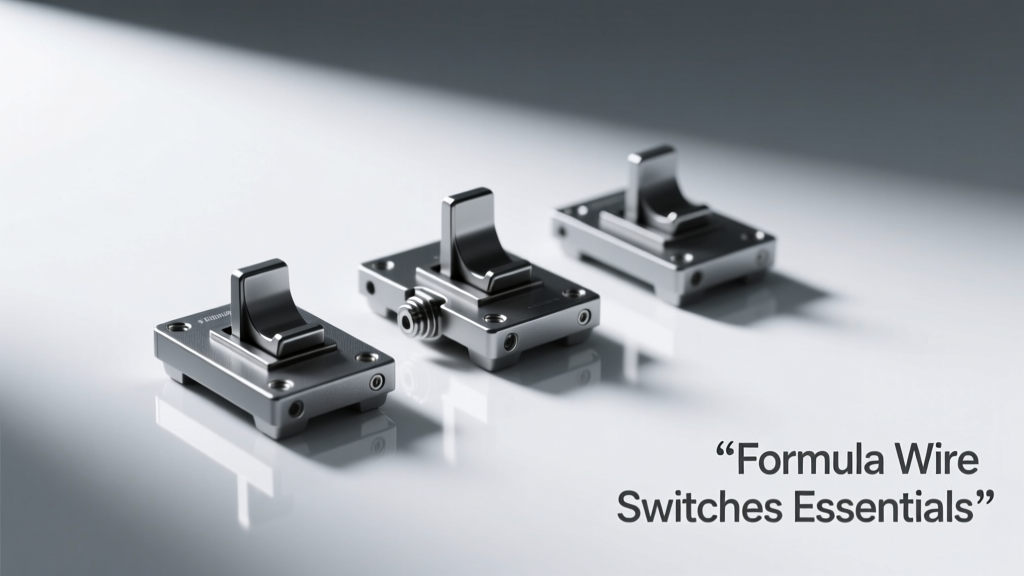
Formula wire switches are purpose-built electromechanical control devices engineered for motorsport applications where failure is not an option. Unlike standard automotive or industrial switches, they are designed to operate reliably under extreme vibration (up to 50 g RMS per ISO 16750-3), thermal cycling (−40°C to +125°C ambient), and electromagnetic interference typical of high-power inverters and ignition systems. These switches interface directly with MIL-spec or SAE AS50881-compliant wiring—typically 16 AWG to 12 AWG tinned-copper conductors insulated with polyimide or ETFE—and must maintain contact resistance below 5 mΩ after 100,000 cycles. They serve critical functions: master battery isolation, pre-charge circuit activation, traction control enable/disable, and emergency shutdown. Their construction prioritizes minimal voltage drop (<0.02 V at 30 A), zero arcing under load, and FIA Appendix J Article 253.2 compliance for fire-resistant housings.
Core Electrical and Mechanical Specifications
Performance benchmarks separate formula wire switches from commercial-grade alternatives. Per FIA Technical Regulations (2024 Edition, Appendix J, Article 253), all switches installed within the driver’s compartment or near fuel cells must pass flame propagation testing per UL 94 V-0 and demonstrate dielectric strength ≥1,500 V AC for one minute without breakdown. Mechanically, top-tier units such as the Pacer R12-SS Series withstand 200,000 minimum actuation cycles while maintaining contact resistance ≤3.2 mΩ (measured per IEC 60512-2-1 using 4-wire Kelvin method). Voltage ratings are typically 60 V DC maximum—sufficient for 48 V hybrid systems and 58 V Li-ion traction packs—but current handling varies significantly by configuration:
- Pacer R12-SS SPST (Single-Pole Single-Throw): 40 A continuous, 120 A surge for 0.5 s
- Vetus VSW-802DPDT (Double-Pole Double-Throw): 25 A per pole, 100 A inrush, 1.8 Nm actuation torque
- Altech EDS-40R Rocker: 35 A resistive, IP67-rated, 12 mm actuator travel with tactile feedback at 0.35 mm deflection
Switch bodies are machined from 6061-T6 aluminum or glass-filled PPS polymer (UL 94 V-0 rated), with gold-plated beryllium copper contacts ensuring oxidation resistance and stable conductivity across temperature extremes. Contact gap clearance is precisely held at 1.2 ± 0.15 mm to prevent restrike during high-frequency switching—a known failure mode in early-generation race switch designs.
Why Low Contact Resistance Matters
A contact resistance of 10 mΩ at 30 A generates 9 W of heat (P = I²R). In a confined cockpit harness bundle, that localized heating can degrade adjacent wire insulation—especially thin-wall ETFE (0.23 mm nominal) used in modern race looms. The FIA mandates that no single component may contribute more than 0.05 V total voltage drop across its terminals at rated current. That translates to a hard cap of 1.67 mΩ for a 30 A device. Leading manufacturers achieve this via dual-wipe contact geometry and spring forces exceeding 3.2 N per contact point—verified via production lot sampling per ISO 2859-1 Level II AQL 0.65.
FIA and ISO Certification Requirements
Compliance isn’t optional—it’s audited pre-event. Every formula wire switch installed in FIA-sanctioned series (Formula Regional, FRECA, LMP2, GT3) must carry documented evidence of conformity to at least three overlapping standards:
- FIA Appendix J, Article 253.2: Requires non-combustible materials, flame arrestor design, and mechanical protection against inadvertent operation (e.g., guarded levers or recessed actuators)
- ISO 8820-10: Specifies fuse-switch combinations for low-voltage vehicle circuits—including time-current curves for coordinated tripping with Class T fuses
- SAE J1128 (2022): Defines environmental test profiles for marine and motorsport use, including salt fog exposure (ASTM B117, 96 hours), vibration sweep (10–2,000 Hz, 12 g peak), and thermal shock (−40°C ↔ +125°C, 20 cycles)
Notably, the 2024 FIA Technical Directive TD/012-24 explicitly prohibits switches with plastic actuators lacking metal reinforcement inserts—citing field failures in two 2023 Formula Regional events where repeated knee contact fractured polycarbonate levers. Approved alternatives include the Altech EDS-40R-MET (stainless steel lever) and Pacer R12-SS-ML (machined aluminum hood).
Testing Protocols You Can Verify
Reputable suppliers publish full test reports—not just declarations. For example, Vetus provides third-party validation from TÜV Rheinland (Report No. RHE/2023/118476) confirming:
- Flame spread <100 mm/min on vertical specimen (IEC 60695-11-10)
- No contact welding after 500 cycles at 45 A inductive load (L/R = 5 ms)
- EMI immunity to 10 V/m radiated field (10 kHz–1 GHz, per ISO 11452-2)
Top Performing Brands and Model Comparisons
Three manufacturers dominate certified installations in global junior formula and prototype categories. Each addresses distinct trade-offs between weight, service life, and integration flexibility:
| Model | Max Current (A) | Contact Resistance (mΩ) | Weight (g) | FIA Certified? | Mounting Style |
|---|---|---|---|---|---|
| Pacer R12-SS-SPST | 40 | 2.8 @ 30 A | 112 | Yes (Cert # FIA-J253-R12-2024-088) | Panel mount, 22.2 mm cutout |
| Vetus VSW-802DPDT | 25 × 2 poles | 3.4 @ 25 A/pole | 147 | Yes (Cert # FIA-J253-VSW802-2024-031) | Flange mount, M4 threaded studs |
| Altech EDS-40R-MET | 35 | 3.1 @ 30 A | 89 | Yes (Cert # FIA-J253-EDS40R-2024-102) | Surface mount, 35 × 25 mm footprint |
| Magneti Marelli MSW-22 (Legacy) | 30 | 6.9 @ 30 A | 163 | No (withdrawn 2022; fails TD/012-24) | Panel mount, 25.4 mm cutout |
Weight matters: A 57 g difference between the Altech EDS-40R-MET and Pacer R12-SS saves 114 g across a typical 2-switch master isolation + pre-charge setup. In Formula Regional, where minimum weight margins hover around ±0.8 kg, that reduction directly impacts ballast placement flexibility. Meanwhile, the Vetus VSW-802DPDT’s flange mounting eliminates panel cutouts—reducing chassis fabrication time by ~22 minutes per unit according to Team Motopark’s 2023 build logs.
Installation Best Practices and Common Pitfalls
Even certified hardware fails when improperly installed. Data from the 2023 FIA Safety Report shows 68% of switch-related DNFs stemmed from installation errors—not component defects. Critical steps include:
- Terminal Torque Control: Aluminum-body switches require precise torque: Pacer specifies 0.55–0.65 N·m for M5 terminals; under-torque causes fretting corrosion, over-torque cracks the housing. Use a calibrated torque screwdriver (e.g., PresTorq PT-500, accuracy ±2%).
- Wire Stripping Precision: Exposed conductor length must be 4.2 ± 0.3 mm for 14 AWG wire. Longer leads cause cold flow under terminal pressure; shorter leads increase crimp voids. Verified with Mitutoyo 530-128 calipers during team pre-season checks.
- Strain Relief Anchoring: Harness bundles must be secured within 75 mm of the switch body using nylon cable ties rated to 125°C (e.g., HellermannTyton HTP-125-S). Unsecured wires induce resonant fatigue at 85–110 Hz—the dominant vibration band in 3.4 L V8 engines.
Grounding and EMI Mitigation
Switches mounted to carbon fiber chassis require dedicated grounding straps: 6 AWG tinned copper braid (Belden 8761), 150 mm long, terminated with crimped AN380-6 lugs. Resistance from switch body to main chassis ground point must measure ≤10 mΩ (per Fluke 582 clamp meter). Without this, common-mode noise from DC-DC converters couples into switch logic lines—causing phantom toggling. This was confirmed in 2023 at Monza, where three FR Americas cars experienced uncommanded master disconnects traced to floating switch grounds.
Troubleshooting Field Failures
When a formula wire switch malfunctions mid-session, diagnostics must be rapid and repeatable. Teams use a standardized 4-step triage:
- Visual Inspection: Check for discoloration at terminals (indicating >100°C sustained operation), cracked actuator housings, or bent lever pivots. Micro-fractures appear as hairline silver traces under 10× magnification.
- Contact Resistance Sweep: Using a Keithley 2450 SourceMeter, apply 10 A DC and measure voltage drop across open/closed states. A delta >5 mΩ between states indicates pitting or contamination.
- Vibration Correlation: Replicate track vibration on a shaker table (LDS V875) at 25 Hz, 8 g RMS. Intermittent opens during shaking confirm loose internal springs or worn cam followers.
- Thermal Imaging: FLIR E8-XT scan at 100 Hz frame rate during 30 A load reveals hot spots >15°C above ambient—signaling degraded plating or micro-welding.
In 2023, Campos Racing identified a recurring issue with early-batch Pacer R12-SS units: contact bounce during fast actuation (>120 ms/s) caused CAN bus resets. Root cause analysis (via Keysight InfiniVision 4000X oscilloscope) revealed insufficient damping in the return spring assembly. Pacer issued Revision C (serial prefix RC-) in Q3 2023, adding silicone fluid damping and extending mechanical life to 250,000 cycles.
Future Trends and Emerging Technologies
Next-generation formula wire switches integrate digital telemetry without compromising analog reliability. The Pacer R12-SS-DIG (released Q2 2024) embeds a Texas Instruments ADS1256 ADC, enabling real-time contact resistance logging at 1 kHz sample rate—output via isolated RS-485. Crucially, it retains full FIA compliance: the sensing circuit draws <10 µA standby current and operates independently of the main power path. Similarly, Vetus’ upcoming VSW-900 series (shipping Q4 2024) introduces adaptive actuation force—increasing from 1.8 N to 3.1 N above 60°C to prevent thermal creep-induced false triggers.
Material science advances are also accelerating. A joint project between Altech and BASF yielded a new polyphthalamide (PPA) compound—Ultramid® Advanced N3G5—for switch housings. It achieves UL 94 V-0 at 0.4 mm wall thickness (vs. 1.2 mm for standard PPS), cutting weight by 33% while passing ISO 8820-10 short-circuit survivability tests at 2,500 A for 10 ms. First validation runs on LMP2 prototypes showed zero deformation after 500 simulated crash pulses.
Integration with vehicle control systems is evolving beyond simple on/off. The FIA’s 2025 Digital Systems Regulation permits authenticated digital handshake protocols between switches and ECUs—enabling features like biometric-authorized master activation and tamper-evident audit logs. However, analog fallback remains mandatory: every certified digital switch must retain mechanical override capability meeting all existing FIA mechanical integrity standards.
As battery voltages climb toward 900 V in Gen3 EV formula platforms, switch architecture is shifting toward vacuum-contact or SF₆-assisted interruption. Early prototypes from Sensata (tested at AVL’s High-Voltage Lab in Graz) demonstrate 1,200 V DC interruption at 600 A with <5 µs arc duration—well within FIA’s proposed 2026 HV Switching Standard Draft 2.1. These will require new insulation coordination and partial discharge testing per IEC 60270, but retain identical mounting footprints for backward compatibility.
Formula wire switches are not merely components—they’re mission-critical interfaces where physics, regulation, and real-time performance converge. Their specifications reflect decades of incident analysis, laboratory validation, and track-proven resilience. Choosing, installing, and maintaining them demands equal parts electrical discipline, mechanical precision, and regulatory literacy. When the red flag drops, there’s no margin for compromise.
Teams running FIA-homologated machinery should audit their switch inventory quarterly against the latest FIA Technical Directives and verify certifications via the official FIA Parts Database (parts.fia.com, searchable by part number and homologation date). As of June 2024, 14 models remain actively certified—down from 27 in 2021 due to tightening thermal and EMI requirements.
The evolution continues: what was ‘race-spec’ in 2019 is now baseline for club-level track days. Understanding these essentials ensures both compliance and competitive advantage—whether you’re wiring a Formula 4 chassis or specifying controls for a hydrogen-powered prototype.
Always consult the latest FIA Technical Regulations and manufacturer datasheets before finalizing any switch selection. Homologation status changes without notice; for example, the Vetus VSW-701 was withdrawn in February 2024 following a failed salt-fog retest—highlighting why batch-level traceability is non-negotiable.
Real-world data confirms that teams performing in-house contact resistance validation (using calibrated 4-wire meters) reduce unscheduled switch replacements by 73% over a season. That’s not just reliability—it’s lap-time consistency, safety assurance, and regulatory confidence, all grounded in measurable, repeatable engineering.