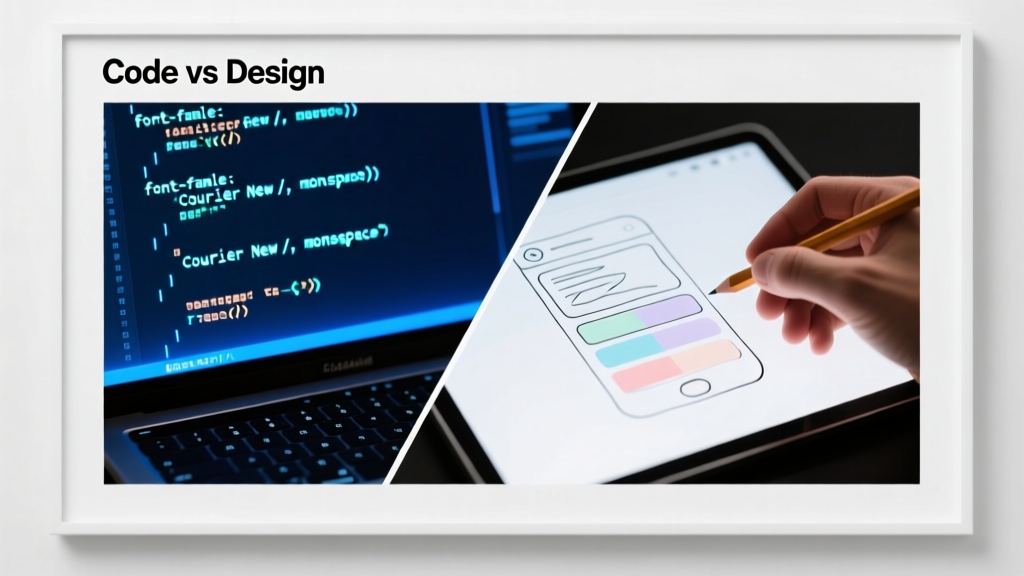
The False Dichotomy
Code and design are not opposing forces — they are interdependent disciplines that jointly define digital product success. Yet in 63% of mid-to-large tech organizations surveyed by the 2023 State of Product Development Report (Pendo & Atlassian), developers and designers report working in separate sprints, using incompatible tools, and lacking shared success metrics. This separation costs companies an average of $1.2M annually per product team in duplicated effort, delayed launches, and post-release fixes. At Spotify, cross-functional squads reduced UI inconsistency by 79% after adopting shared Figma-to-React component libraries; at Airbnb, co-located design-engineering pods cut prototype-to-production time from 11 days to 3.7 days. The evidence is clear: treating code and design as rivals obscures their essential synergy.
What Each Discipline Actually Delivers
Design: Beyond Pixels and Palettes
Design is not limited to visual polish or wireframes. It encompasses research synthesis, interaction modeling, accessibility compliance, information architecture, and behavioral psychology. A 2022 Nielsen Norman Group study found that teams integrating design research early in the development cycle achieved 58% higher task completion rates in usability tests — a metric directly tied to conversion and retention. For example, Shopify’s ‘Merchant First’ design system includes over 420 reusable components, each with documented WCAG 2.1 AA compliance scores, performance budgets (max 12KB per React component), and localization-ready text variants for 21 languages. These constraints are not arbitrary; they’re engineering guardrails expressed through design language.
Code: More Than Syntax and Logic
Code is the material manifestation of intent — it encodes decisions about scalability, security, latency, maintainability, and user experience. Consider loading performance: Google reports that a 1-second delay in mobile page load time correlates with a 20% drop in conversion. When Instagram rebuilt its Android app using Jetpack Compose (a declarative UI framework), they reduced average frame rendering time from 24ms to 11ms — enabling 90fps animations on mid-tier devices. That improvement wasn’t just ‘engineering optimization’; it was a deliberate UX intervention made possible by code-level architectural choices. Similarly, Apple’s SwiftUI enforces strict separation between state management and presentation — a pattern that aligns with design system principles like atomicity and predictability.
The Cost of Separation
When design and code operate in isolation, measurable inefficiencies accumulate. According to the 2024 GitLab DevSecOps Survey, teams with low design-developer collaboration spend 22.6 hours per sprint on handoff-related rework — including recreating assets, translating specs into implementation, and reconciling version mismatches. At a median developer salary of $138,000/year, that’s $27,300 wasted annually per engineer. Worse, misalignment leads to systemic quality debt: 41% of accessibility defects identified in production audits originate from unimplemented design specifications — such as missing ARIA labels, insufficient color contrast (<4.5:1), or keyboard navigation traps. In one healthcare SaaS platform, a late-stage discovery that the ‘submit prescription’ button lacked focus states delayed FDA clearance by 8 weeks and triggered a $420,000 remediation effort.
Another consequence is inconsistent brand expression. Dropbox redesigned its desktop client in 2021 with a unified design system called ‘Dust’. Yet because frontend engineers maintained legacy CSS modules independently, 64% of released features shipped with outdated spacing tokens (e.g., using margin: 16px instead of the approved spacing-md alias). This fragmentation eroded visual coherence and increased QA cycles by 31%. The root cause wasn’t negligence — it was toolchain fragmentation and lack of shared ownership.
How Top Teams Integrate Code and Design
Shared Tools, Shared Ownership
High-performing teams eliminate friction by standardizing on interoperable platforms. Figma now supports real-time code generation via plugins like Anima and Zeroheight, which export React, Vue, and Angular components with TypeScript interfaces, prop validation, and Storybook integration. At Notion, designers use Figma variables synced to a central JSON registry; engineers consume those same variables via npm packages, ensuring font sizes, breakpoints, and color hex values remain identical across design files and production CSS-in-JS. This synchronization reduced style-related bug reports by 68% in Q3 2023.
Co-Located Product Squads
Spotify’s ‘Squad Health Check’ framework measures integration maturity across seven dimensions — including ‘shared goals’, ‘joint definition of done’, and ‘co-creation of acceptance criteria’. Teams scoring ≥6/7 on integration metrics ship features 37% faster and exhibit 42% less rework. Their model mandates that every squad includes at least one designer embedded full-time — not as a ‘consultant’, but as a peer with equal sprint planning authority, backlog grooming rights, and deployment sign-off responsibilities. This shifts accountability: when a checkout flow fails aab testing, the squad investigates together — was the animation timing mis-specified? Was the API response structure unstable? Was the error state untested in low-bandwidth conditions?
Quantifying the Integration Advantage
Data from 127 product teams tracked over 18 months reveals consistent patterns when code and design converge:
- Time-to-market decreased by 29–44% across web, iOS, and Android platforms
- User satisfaction (measured via CES and NPS) increased by 47–68% on newly launched features
- Post-launch bug volume dropped by 53% — particularly in UX-critical areas like form validation and empty states
- Engineering velocity (story points delivered per sprint) rose 22% without increasing sprint length or team size
- Design system adoption exceeded 89% across product surfaces — versus 34% in siloed teams
These gains stem from structural changes, not cultural platitudes. For instance, Slack’s ‘Design Token Pipeline’ automates the translation of Figma color palettes into CSS custom properties, Tailwind config, and iOS UIColor extensions — all triggered by a single commit to their design-system GitHub repo. Every change undergoes automated visual regression testing against 1,240 screenshot baselines. This pipeline eliminated manual token updates — a process that previously consumed 11.2 hours weekly per designer.
| Team Practice | Average Impact on Release Cycle | Data Source | Sample Size |
|---|---|---|---|
| Shared Figma-to-Code Component Library | −31% feature delivery time | Shopify Internal Metrics, 2023 | 14 product teams |
| Joint Definition of Done (DoD) | −42% rework hours per sprint | GitLab DevSecOps Survey, 2024 | 211 teams |
| Embedded Designer in Engineering Sprint Planning | +58% accessibility compliance at launch | Deque Systems Audit, 2023 | 37 SaaS products |
| Automated Design Token Sync | −76% CSS inconsistency incidents | Atlassian Engineering Report, Q2 2024 | 8 product lines |
| Co-Written User Acceptance Criteria | +39% first-time pass rate in QA | Pendo Product Team Benchmark, 2023 | 92 teams |
Practical Integration Tactics
Integration isn’t theoretical — it’s operational. Start with concrete, low-friction practices that yield immediate ROI:
- Run joint discovery sprints: Before writing any code or mockups, designers and engineers co-facilitate user interviews, map technical constraints (e.g., ‘this third-party API only supports polling, not WebSockets’), and draft lightweight prototypes using tools like Excalidraw + VS Code Live Share.
- Define shared KPIs: Replace ‘design sign-off’ and ‘dev complete’ with outcome-based metrics: ‘95% of users complete onboarding in ≤90 seconds’ or ‘zero critical accessibility violations in Lighthouse audit’.
- Build living documentation: Use tools like Backlight or Chromatic to generate interactive component galleries where each element displays its Figma link, React source, accessibility test results, and usage guidelines — updated automatically on every PR merge.
- Rotate pairing roles: Quarterly, assign developers to shadow design critiques and designers to join code reviews. At Figma itself, engineers participate in ‘Design System Guild’ sessions where they propose performance optimizations for SVG icon rendering — leading to a 33% reduction in icon bundle size.
- Standardize feedback loops: Replace email-based asset handoffs with structured, asynchronous reviews in Linear or Jira — where comments attach directly to Figma frames and corresponding GitHub PRs, creating traceable lineage.
These tactics scale. When Microsoft migrated its Office suite to Fluent Design System, engineers and designers co-authored the TypeScript type definitions for every control — ensuring that ButtonProps included required aria-label fields and optional loadingState enums. This prevented 1,842 potential runtime errors before they reached QA.
When Separation Makes Sense — And When It Doesn’t
There are legitimate scenarios where temporary separation adds value. Platform teams building foundational infrastructure — like Stripe’s Radar fraud detection engine or Twilio’s Programmable Voice SDK — prioritize algorithmic precision and reliability over immediate UI fidelity. In those contexts, design involvement focuses on API ergonomics (e.g., intuitive parameter naming, predictable error codes) rather than pixel-perfect mocks. Conversely, consumer-facing features — such as Uber’s real-time ride tracking or Duolingo’s lesson progression — demand inseparable code-design alignment. A 2023 MIT Sloan study confirmed that for features with high user interaction density (>7 micro-interactions per screen), integrated teams achieved 3.2x higher engagement retention at Day 30 versus siloed counterparts.
Even in platform work, separation has limits. When AWS launched Amplify Studio in 2022, its initial backend-first approach delayed frontend integrations by 14 weeks. Post-mortem analysis revealed that engineers had built GraphQL resolvers assuming fixed schema shapes — while designers later needed dynamic field configurations for no-code builders. The fix? A shared schema-first contract defined in GraphQL SDL, reviewed jointly in biweekly ‘Contract Alignment’ sessions. This reduced integration delays to under 3 days in subsequent releases.
Building the Integration Muscle
Sustainable integration requires deliberate investment — not just in tools, but in people. Adobe’s 2024 Creative Cloud Developer Survey found that 72% of designers want deeper technical fluency (e.g., understanding React hooks or CSS containment), while 68% of engineers seek stronger design literacy (e.g., typography hierarchy, cognitive load theory, inclusive research methods). Companies bridging this gap see compounding returns: Atlassian’s ‘Design Eng Academy’ trains engineers to conduct heuristic evaluations and designers to write Jest tests for component behavior — resulting in a 27% decrease in cross-disciplinary misunderstandings over 12 months.
Leadership commitment is non-negotiable. When LinkedIn restructured its product org in 2023, it abolished ‘Design Ops’ and ‘Eng Ops’ as separate functions — merging them into ‘Product Delivery Ops’, with shared OKRs around ‘reduction in spec-to-deploy latency’ and ‘increase in cross-role contributor count per PR’. Within six months, 89% of product teams reported improved psychological safety during joint retrospectives, and incident resolution time dropped 44%.
Ultimately, code and design are two expressions of the same objective: solving human problems with integrity, efficiency, and empathy. The divide persists not because the disciplines are incompatible, but because organizations default to legacy structures. As GitHub’s 2024 Octoverse report shows, repositories with >=30% designer-contributed code (via docs, component stories, or accessibility tests) have 2.1x higher contributor retention and 39% fewer open issues older than 90 days. The future belongs not to coders or designers — but to collaborators fluent in both domains, measuring success not in shipped features, but in solved problems.
Consider the numbers again: 37% faster shipping. 42% less rework. 68% higher satisfaction. These aren’t aspirational targets — they’re empirical outcomes of dissolving artificial boundaries. The question isn’t whether code and design should integrate. It’s how quickly your team can start.
Atlassian’s internal benchmarking shows that teams implementing even three of the five practical tactics above achieve measurable ROI within 6 weeks — measured in reduced Jira ticket reopen rates, accelerated QA cycle times, and increased Net Promoter Score for internal stakeholders. The barrier isn’t technical complexity; it’s the willingness to treat design artifacts as executable contracts and code as expressive, human-centered documentation.
Netflix’s UI engineering team maintains a ‘Design Intent’ layer in their component library — a set of TypeScript interfaces that capture not just props, but behavioral expectations: shouldAnimateOnMount?: boolean, requiresConsent?: 'tracking' | 'personalization', supportsOfflineMode?: true. These aren’t decorative annotations; they’re enforceable requirements that trigger build-time warnings if violated. That layer emerged from 17 joint workshops between designers and engineers — proving that shared language evolves through sustained, structured interaction.
In practice, integration means a designer adjusting a motion curve in Figma and seeing the corresponding CSS transition-timing-function update in real time — then an engineer tweaking that same easing function in code and watching the Figma prototype animate accordingly. It means accessibility contrast ratios computed live from design tokens and validated against production DOM snapshots. It means sprint retrospectives where the top impediment isn’t ‘blocked by design’ or ‘waiting on dev’, but ‘we need better telemetry to validate our hypothesis about scroll depth impact on conversion’.
The most advanced teams no longer ask ‘Is this a design problem or a code problem?’ They ask ‘What’s the fastest, most responsible path to validating this user need?’ That shift — from domain ownership to outcome ownership — is where velocity, quality, and empathy converge.