
The Physics You Actually Need to Know Before Buying
When designing a circuit that requires non-contact magnetic detection, selecting the right hall magnetic sensor is rarely as simple as picking a generic 'magnet detector.' At their core, these ICs rely on the Lorentz force: when a magnetic field passes through a semiconductor carrying a current, the charge carriers are deflected, creating a measurable transverse voltage. However, the raw Hall voltage is incredibly small—often in the microvolt range. Therefore, you are never just buying a Hall element; you are buying an integrated circuit that includes the Hall plate, a differential amplifier, voltage regulation, and output logic.
Understanding this integration is the first step in the buying process. A bare Hall element is useless without signal conditioning. Modern ICs pack this conditioning into microscopic packages, but the type of conditioning dictates whether the sensor will work for your specific application, be it measuring the RPM of a gas engine, commutating a brushless DC (BLDC) motor, or sensing the angular position of a joystick.
Analog vs. Digital: The Great Divide
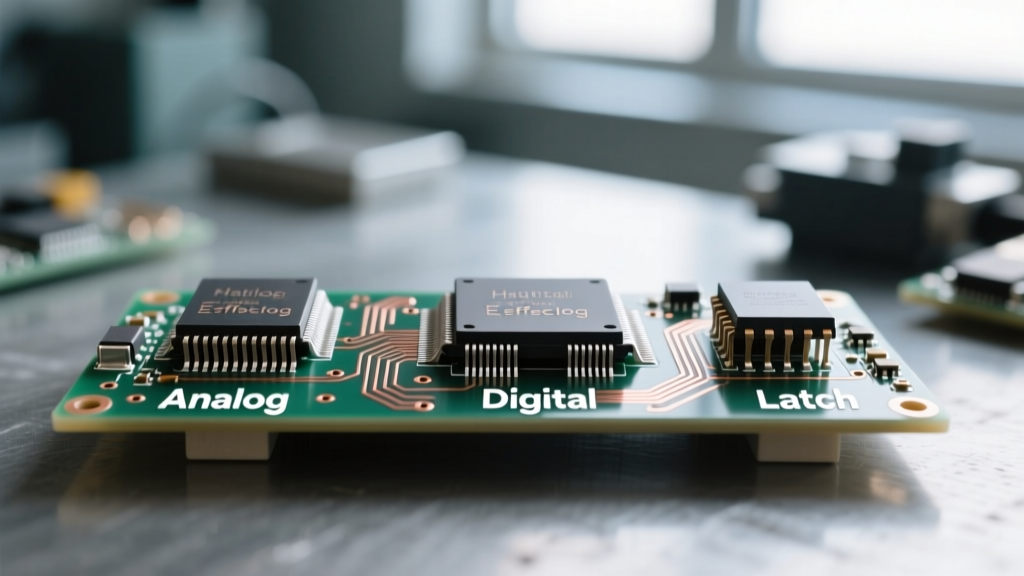
The most critical fork in the road when purchasing a hall magnetic sensor is choosing between an analog (linear) output and a digital (switch/latch) output. Your application's end-goal dictates this choice entirely.
Linear and Ratiometric Sensors (Precision Positioning)
Linear Hall sensors output a continuous voltage that is directly proportional to the magnetic flux density (measured in Gauss or milli-Tesla) passing through the die. If you are building a DIY joystick, a linear slide potentiometer replacement, or a precision fluid level gauge, you need a linear sensor like the SS49E or Texas Instruments' DRV5055.
When buying linear sensors, you must check if the output is ratiometric. A ratiometric sensor scales its output voltage based on the supply voltage (VCC). If your microcontroller's ADC uses the same VCC as its reference voltage, a ratiometric sensor cancels out power supply noise, providing highly stable readings even if your battery voltage sags.
Unipolar Switches (The A3144 Standard)
Digital switches act as simple on/off triggers. The legendary A3144 (and its modern Allegro equivalents like the A1120) is a unipolar switch. It triggers its output LOW when a specific magnetic threshold (the Operate Point, or $B_{OP}$) is exceeded by a single pole (usually the South pole). When the field drops below the Release Point ($B_{RP}$), the output returns HIGH. These are ideal for tachometers, RPM counters, and simple proximity limits where you only need to know 'is the magnet here or not?'
Bipolar Latches (BLDC Motor Commutation)
Latches are frequently misunderstood and incorrectly purchased for simple proximity tasks. A Hall latch (like the TLE4905 or DRV5012) turns ON when exposed to a strong South pole, but it stays ON even when the magnet is removed. It will only turn OFF when exposed to a strong North pole. This alternating polarity requirement makes latches the undisputed choice for BLDC motor commutation and rotary encoders, where a multi-pole ring magnet spins past the sensor, continuously flipping the output in a perfect square wave.
Decoding the Datasheet: Bop, Brp, and Hysteresis
Amateur buyers look at the voltage rating; professional engineers look at the magnetic thresholds. When reviewing datasheets from manufacturers like Allegro MicroSystems, Melexis, or Diodes Inc., focus on these three parameters:
- Operate Point ($B_{OP}$): The magnetic flux density required to trigger the sensor. Note that 1 milli-Tesla (mT) equals 10 Gauss. For context, the Earth's magnetic field is roughly 0.5 Gauss, while a surface N52 Neodymium magnet can exceed 5,000 Gauss.
- Release Point ($B_{RP}$): The threshold where the sensor resets.
- Hysteresis ($B_{HYS}$): The difference between $B_{OP}$ and $B_{RP}$. This is the most vital spec for mechanical assemblies. If a sensor has zero hysteresis, mechanical vibration will cause the magnet to hover exactly on the threshold, resulting in rapid, destructive 'chatter' (dozens of triggers per second). A healthy hysteresis of 15 to 30 Gauss ensures clean, single transitions.
Pro-Tip: Always check the 'Thermal Drift' coefficient in the datasheet. Silicon-based Hall elements naturally drift as temperature rises. A sensor calibrated for 30 Gauss at 25°C might trigger at 22 Gauss at 85°C. High-end automotive ICs include active thermal compensation circuitry to lock these thresholds across a -40°C to 150°C range.
Real-World Hall Magnetic Sensor Comparison Chart
Below is a breakdown of the most common ICs you will encounter on distributor shelves, categorized by their optimal use cases.
| IC Model | Type | Typical $B_{OP}$ | Output Topology | Best Application |
|---|---|---|---|---|
| Allegro A3144 | Unipolar Switch | 35 Gauss | Open-Collector | RPM sensing, limit switches |
| Honeywell SS49E | Linear | N/A (Continuous) | Push-Pull Analog | Joysticks, linear actuators |
| TI DRV5055 | Linear Ratiometric | N/A (Continuous) | Push-Pull Analog | Angle sensing, fluid levels |
| Infineon TLE4905 | Bipolar Latch | 7.5 mT (75 G) | Open-Collector | BLDC commutation, encoders |
| Allegro ACS712 | Current Sensor | Internal Core | Analog (Isolated) | AC/DC current monitoring |
Package Topologies: UA vs. CB vs. LP
The physical package dictates how you mount the sensor relative to the magnet, which directly impacts your magnetic circuit design.
- TO-92 (UA / Straight): The classic through-hole package. The sensitive face is typically the flat branded side. Ideal for breadboarding and mounting on the edge of a PCB to detect a magnet passing by on a rotating wheel.
- SOT-23 (CB / Surface Mount): The sensitive area is on the top face of the package. This is perfect for mounting on the underside of a PCB, allowing a magnet to pass over the top of the board with minimal air gap.
- USON / DSBGA (LP / Ultra-Compact): Used in modern wearables and smartphones. These offer incredibly low profile heights (under 0.6mm) but require advanced reflow soldering skills and are highly susceptible to mechanical stress cracking.
Prototyping Pitfalls: The Open-Collector Trap
The most common reason DIYers believe their new hall magnetic sensor is 'dead on arrival' is a fundamental misunderstanding of open-collector outputs. Digital switches like the A3144 or TLE4905 do not output a HIGH voltage. Instead, they contain an internal NPN transistor that pulls the output pin to GROUND when activated. When deactivated, the pin is left floating.
If you wire an open-collector output directly to an Arduino or ESP32 GPIO pin without a pull-up resistor, the microcontroller will read random noise when the magnet is absent. You must install a 10kΩ pull-up resistor between the sensor's output pin and your logic VCC (3.3V or 5V). Alternatively, purchase sensors with 'Push-Pull' outputs (like the DRV5013), which actively drive the pin both HIGH and LOW, eliminating the need for external resistors.
Sourcing Strategy: Genuine vs. Clone ICs
Because Hall sensors are ubiquitous in automotive and industrial applications, the market is flooded with clones. You can find packs of 50 'A3144' sensors on marketplaces like AliExpress for under $2.00. While these may work for a simple bicycle speedometer, they often lack internal thermal compensation and ESD protection. In an automotive or high-reliability environment, these clones will fail catastrophically when exposed to voltage spikes or summer heat.
For mission-critical projects, always source from authorized distributors. According to DigiKey's technical library on Hall sensors, verifying the supply chain is essential to ensure the silicon meets the published Gauss thresholds. Furthermore, when designing for high-current environments, engineers should consult resources like Texas Instruments' SLAA712 application note to understand how to properly layout PCB traces to prevent EMI from corrupting the sensitive analog amplification stages inside the IC.
Ultimately, buying the right hall magnetic sensor requires matching the magnetic topology of your mechanical design to the logic output required by your microcontroller. Define your hysteresis needs, respect the open-collector rules, and your sensor will provide years of frictionless, bounce-free data.