
If you have ever found yourself asking, "is copper insulator or conductor?", you are likely holding a piece of electrical wire and wondering about the fundamental physics governing your project. The short, unequivocal answer is that copper is a highly efficient electrical conductor. In fact, it is the global benchmark against which all other conductive materials are measured. However, in real-world electrical applications, the story is slightly more nuanced. Under specific environmental and thermal stresses, copper can develop surface layers that actually act as insulators, leading to dangerous failure modes in DIY and professional wiring alike.
In this guide, we will explore the atomic reality of copper, examine the metrics that make it the king of conductivity, and dive deep into the real-world scenarios where copper connections fail, effectively turning a conductor into a high-resistance barrier.
The Atomic Architecture: Why Copper Conducts
To understand why copper is a conductor, we have to look at its atomic structure. Copper (Atomic Number 29) possesses a single valence electron in its outermost shell. In a solid copper wire, these outer electrons detach from their parent atoms and form what physicists call a "sea of free electrons."
When a voltage (electrical pressure) is applied across a copper wire, this sea of electrons drifts uniformly in one direction, creating an electrical current. Because these electrons are loosely bound and highly mobile, they encounter very little atomic friction (resistance) as they move through the copper crystal lattice. This fundamental property is why the Copper Development Association and global engineering bodies rely on copper for everything from microchip interconnects to high-voltage transmission lines.
The IACS Standard and Material Comparison
In electrical engineering, conductivity is often measured using the International Annealed Copper Standard (IACS). By definition, pure annealed copper is assigned an IACS value of 100%. Let us look at how copper stacks up against other common metals used in electronics and wiring, utilizing data verified by the National Institute of Standards and Technology (NIST).
| Material | Resistivity (nΩ·m at 20°C) | IACS Conductivity % | Real-World Application |
|---|---|---|---|
| Silver | 15.9 | 105% | High-end audio contacts, aerospace relays |
| Copper (Annealed) | 17.2 | 100% | Standard branch circuit wiring, PCB traces, motor windings |
| Gold | 24.4 | 70% | Corrosion-resistant connector plating, IC bonding wires |
| Aluminum | 28.2 | 61% | Overhead transmission lines, heavy feeder cables |
While silver is technically a better conductor, copper's vastly superior cost-to-performance ratio and mechanical ductility make it the undisputed standard for 99% of residential and commercial wiring.
When Copper Fails: The "Insulator" Misconception
While pure copper is a phenomenal conductor, real-world electricians and DIYers sometimes encounter situations where a copper connection behaves more like an insulator. This is not a failure of the copper itself, but rather a failure of the surface environment.
The Danger of Copper Oxide and Verdigris
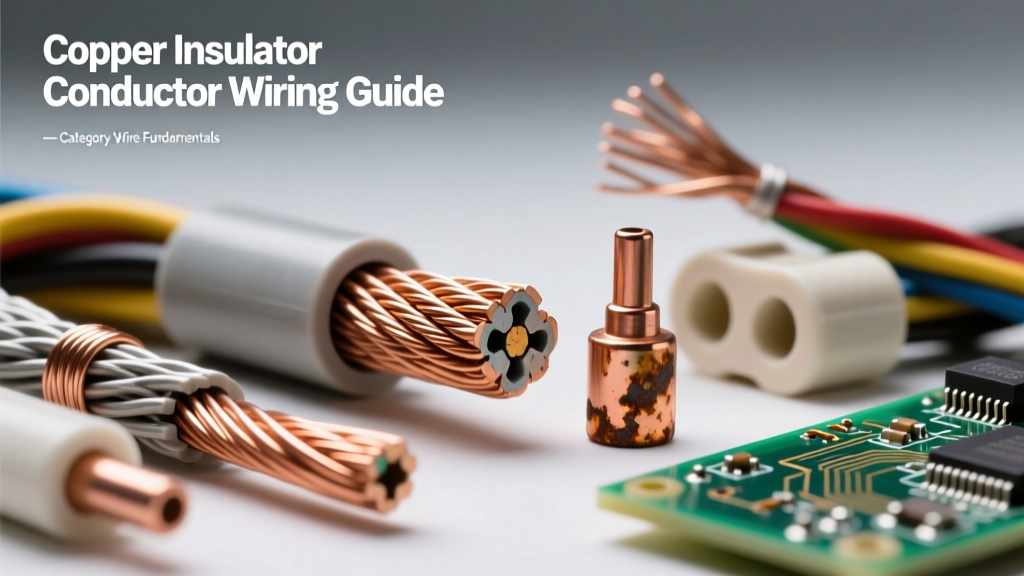
When copper is exposed to oxygen, heat, and moisture, it undergoes chemical reactions that create surface compounds. Unlike aluminum oxide, which is a hard, immediate insulator, copper oxide (CuO and Cu2O) forms more slowly. However, copper(II) oxide is a semiconductor and can act as a high-resistance insulator in low-voltage DC circuits or signal lines.
More commonly in residential AC wiring, you may see a green, crusty buildup on copper wires. This is verdigris (copper carbonate or copper sulfate), which forms when copper reacts with moisture and environmental acids or sulfur. Verdigris is an electrical insulator. If this crust forms under a wire nut or inside a terminal block, it increases contact resistance. According to Joule's Law ($P = I^2R$), increased resistance at a connection point generates excessive heat, which accelerates further oxidation, creating a thermal runaway loop that can melt insulation and start electrical fires.
Galvanic Corrosion: The Dissimilar Metal Trap
Another scenario where copper loses its conductive edge is when it is improperly mated with aluminum. If a copper wire is directly terminated to an aluminum lug without proper anti-oxidant compound and bimetallic connectors, galvanic corrosion occurs. The resulting corrosion products are non-conductive salts that physically push the metals apart, introducing an insulating barrier that leads to arcing and failure.
The True Insulators: What Actually Wraps the Copper
Since we have established that copper is the conductor, we must rely on true dielectric materials (insulators) to keep the current contained within the wire. The National Electrical Code (NEC) strictly regulates the types of insulation used over copper conductors based on environmental factors and temperature ratings.
- PVC (Polyvinyl Chloride): The most common insulation for indoor wiring (e.g., THHN/THWN). It is highly dielectric, flexible, and resistant to most chemicals, typically rated for 75°C to 90°C.
- XLPE (Cross-Linked Polyethylene): Used in high-temperature and high-voltage applications (e.g., XHHW). The cross-linking process creates a thermoset material that will not melt under extreme heat, maintaining its insulating properties even in harsh conditions.
- PTFE (Teflon): Found in aerospace, military, and high-end electronics. PTFE offers incredible dielectric strength and can withstand temperatures exceeding 250°C without degrading.
- EPR (Ethylene Propylene Rubber): Frequently used in medium-voltage underground cables due to its excellent moisture resistance and high dielectric strength.
Real-World Termination Best Practices
Knowing that copper is a conductor is only half the battle; ensuring it stays a conductor at the termination points is where real-world electrical craftsmanship matters. To prevent the formation of insulating oxides and ensure optimal current flow, follow these field-tested rules:
- Use a Calibrated Torque Screwdriver: The NEC now mandates that terminations be tightened to the manufacturer's specified torque. Under-torquing allows micro-movements and air ingress, leading to oxidation. Over-torquing can cold-flow the copper, eventually leading to a loose connection.
- Do Not Over-Strip: Strip only enough insulation to reach the bottom of the terminal. Exposed copper outside the connection point is vulnerable to atmospheric corrosion and accidental shorting.
- Employ Anti-Oxidant Compounds for Mixed Metals: If you must connect copper to aluminum (e.g., at a main service panel lug), use a listed antioxidant paste (like Noalox) and a bimetallic lug to prevent the insulating galvanic corrosion mentioned earlier.
- Clean Before Crimping: When using heavy-gauge copper lugs, ensure the wire strands are bright and clean. If the wire has darkened due to mild oxidation, use a wire brush to restore the bare, conductive copper surface before applying the crimp.
Summary: The Verdict on Copper
Copper is fundamentally a superlative electrical conductor. It is the lifeblood of modern electrical infrastructure. However, its real-world performance relies entirely on proper installation, termination, and environmental protection. When neglected, the chemical byproducts of copper degradation can act as insulators, transforming a perfectly good wire into a dangerous fire hazard.
By understanding both the atomic brilliance of copper and its real-world vulnerabilities, you can design, wire, and troubleshoot electrical systems that remain safe, efficient, and highly conductive for decades.