
The Physics Behind AC Dominance
Before diving into the specific uses of alternating current, it is critical to understand why AC conquered the global power grid over Thomas Edison's direct current (DC) systems. The fundamental advantage of AC lies in its ability to easily change voltage levels using transformers. According to the U.S. Department of Energy, power plants generate electricity at medium voltages, which is then stepped up to 345,000V or higher for long-distance transmission to minimize I²R (heat) losses. Once it reaches a municipality, it is stepped down to safer, usable voltages. DC cannot natively do this without complex, historically unavailable power electronics.
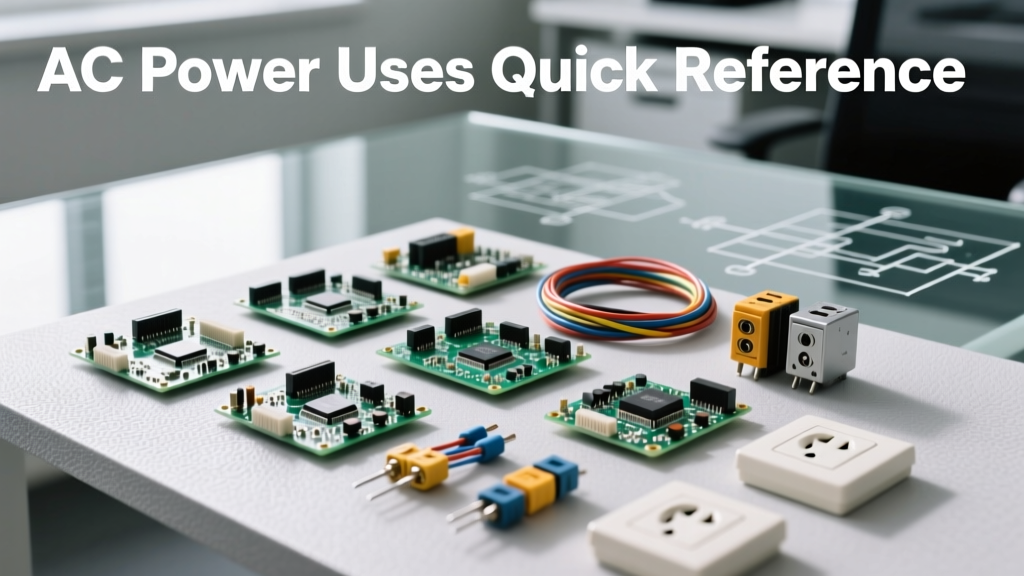
Quick Reference Matrix: Primary Uses of Alternating Current
The following table serves as a rapid diagnostic and planning tool for electricians and engineers identifying AC applications across different sectors.
| Application Sector | AC Configuration | Standard US Voltages | Typical Wire Sizes (AWG/kcmil) | Primary Equipment & Uses |
|---|---|---|---|---|
| Residential | Single-Phase Split | 120V / 240V | 14 AWG to 2 AWG | Lighting, receptacles, electric ranges, HVAC compressors. |
| Light Commercial | Single-Phase / 3-Phase | 120V / 208V | 12 AWG to 1/0 AWG | Office lighting, small elevators, commercial HVAC, POS systems. |
| Heavy Industrial | Three-Phase Wye/Delta | 480V / 277V | 1 AWG to 600 kcmil+ | Induction motors, VFDs, heavy machinery, arc furnaces. |
| Utility Transmission | Three-Phase High Voltage | 69kV to 765kV | 795 kcmil to 2156 kcmil (ACSR) | Grid interconnects, long-distance power transfer, substations. |
Single-Phase vs. Three-Phase Applications
When evaluating the uses of alternating current in the field, you will primarily encounter two distinct polyphase configurations. Each serves a specific mechanical and electrical purpose.
Single-Phase AC (Residential & Light Commercial)
In North America, residential power is delivered as 120/240V single-phase, three-wire split-phase AC. This is achieved via a center-tapped transformer secondary.
- 120V Circuits: Used for general lighting, standard 15A/20A receptacles, and small appliances. The current alternates 60 times per second (60Hz), crossing zero 120 times per second, which inherently helps extinguish arcs in switches and breakers.
- 240V Circuits: Utilized for high-wattage resistive loads like electric baseboard heaters, water heaters, and clothes dryers. By spanning both 'hot' legs, the system delivers double the power without requiring thicker, more expensive wire for the same wattage.
Three-Phase AC (Industrial & Data Centers)
Three-phase AC delivers constant power transfer, unlike single-phase which pulses. This is vital for heavy machinery.
- 208Y/120V: Common in commercial buildings. Provides 120V for standard outlets and 208V for smaller three-phase motors and commercial HVAC units.
- 480Y/277V: The industrial standard. 277V is heavily used for commercial LED and fluorescent lighting ballasts, eliminating the need for step-down transformers. 480V powers massive induction motors and is the input voltage for most Variable Frequency Drives (VFDs).
AC Electric Motors: The Industrial Workhorses
The most significant industrial use of alternating current is the operation of AC motors. The rotating magnetic field inherent to polyphase AC makes these motors incredibly reliable and self-starting.
Expert Insight: Over 90% of industrial AC motor applications utilize the NEMA Design B squirrel-cage induction motor. Because the rotor has no electrical connections (no brushes or slip rings), maintenance is virtually limited to bearing lubrication, making AC the undisputed king of industrial automation.
For applications requiring precise speed control regardless of load (such as large compressors or grid-tied generators), synchronous AC motors are deployed. These lock into the exact frequency of the AC supply (e.g., exactly 1800 RPM for a 4-pole motor on a 60Hz grid).
Wire Sizing Nuances: Skin Effect and AC Resistance
When sizing conductors for AC circuits, DIYers often mistakenly use DC resistance formulas. The National Electrical Code (NEC) Chapter 9, Table 9 specifically lists AC resistance and reactance values because alternating current behaves differently inside a conductor.
Due to the skin effect, alternating current tends to flow primarily near the outer surface of a conductor. At the standard US frequency of 60Hz, the 'skin depth' in copper is approximately 8.5mm.
- For standard residential wires (14 AWG to 2 AWG), the skin effect is negligible, and AC resistance is nearly identical to DC resistance.
- For large industrial feeders (e.g., 500 kcmil to 1000 kcmil), the center of the conductor carries significantly less current. This increases the effective AC resistance, leading to higher voltage drops and heat generation than DC calculations would predict.
Troubleshooting AC Power Quality Issues
Modern uses of alternating current are heavily impacted by non-linear loads (like LED drivers, computer power supplies, and VFDs) that draw current in abrupt pulses rather than smooth sine waves. This introduces specific field issues:
- Harmonic Distortion: Triplen harmonics (3rd, 9th, 15th) do not cancel out in the neutral wire of a three-phase wye system; they add up. This can cause the neutral conductor to overheat, even if the phase currents are perfectly balanced. Solution: Oversize the neutral wire or use K-rated transformers.
- Power Factor Degradation: Inductive AC loads (like motors) cause current to lag voltage, resulting in 'apparent power' that the utility must supply but the load doesn't use for real work. Solution: Install power factor correction capacitor banks to supply reactive power locally.
- Voltage Sags: Large AC motors draw 600% of their full-load current during startup (Locked Rotor Amps). This massive inrush current causes temporary voltage sags across the facility, flickering lights and resetting sensitive PLCs. Solution: Implement soft-starters or VFDs to ramp up the AC voltage gradually.
Summary for Field Technicians
The uses of alternating current span from the 120V receptacle powering your drill to the 765kV transmission lines crossing the country. Mastering AC requires more than just knowing how to wire a plug; it demands an understanding of phase angles, skin effect, harmonic loads, and polyphase motor mechanics. Keep this quick reference matrix on hand when designing panels, sizing feeders, or troubleshooting industrial motor controls to ensure your systems are safe, efficient, and code-compliant.
For deeper study on AC waveform mathematics and impedance, refer to the comprehensive tutorials at All About Circuits.